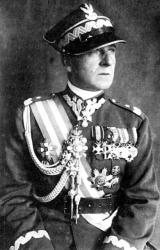
Mihail Lascar
 Romania
- Romanian Military Leader
- Rise Through the Ranks
- World War II
- Recognition and Honors
- Battle of Stalingrad and Capture
- Captivity and Post-War Role
Romanian Military Leader
Early CareerAlexandru Macici, a distinguished Romanian military leader, graduated from the Infantry Officer School in 1910 and began his service as a second lieutenant. He actively participated in the Second Balkan War and World War I.
Rise Through the Ranks
By 1917, Macici had attained the rank of Major. He continued his ascent, becoming a Lieutenant Colonel in 1927, Colonel in 1934, and Brigadier General in 1939.
World War II
On January 10, 1941, Macici assumed command of the 1st Composite Mountain Brigade, which was part of the 11th Army of Army Group South. His troops participated in military operations against the Soviet Union in Northern Bukovina, the Dnieper crossing, and the capture of Crimea.
Recognition and Honors
Macici received numerous accolades for his valor. On September 24, 1941, he was awarded the Order of Michael the Brave, 3rd class, and the German Iron Cross, 2nd class. He was subsequently awarded the Iron Cross, 1st class, on January 7, 1942, and the Knight's Cross on January 18, 1942.
Battle of Stalingrad and Capture
In 1942, Macici was appointed commander of the 6th Infantry Division, which was part of General Friedrich Paulus' group at Stalingrad. After facing heavy casualties, he was forced to surrender on November 22, 1942. On that same day, he received the Oak Leaves to the Knight's Cross. He also received the Order of Michael the Brave, 2nd class, on December 31, 1942, but it arrived after his capture.
Captivity and Post-War Role
During his time as a prisoner of war, Macici was interned in various camps, including those near Suzdal and Ivanovo. In 1945, he was appointed commander of the 2nd Romanian Volunteer Division in Soviet captivity. However, the division did not see combat before the end of the war.