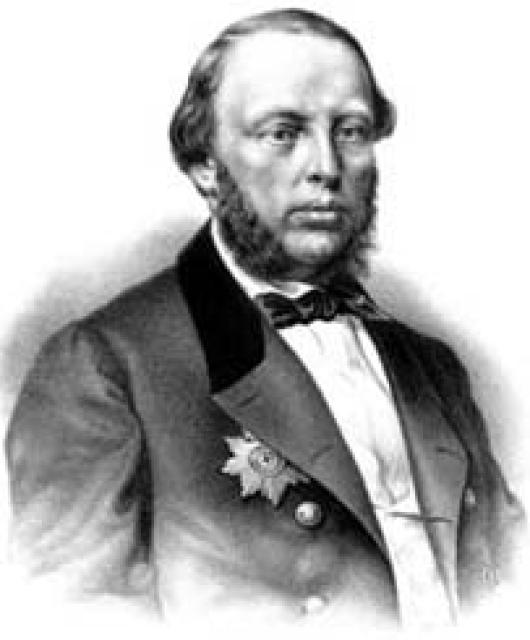
Mihail Reytern
 Russia
- Education and Early Career
- Ministry of the Navy and Railway Committee
- Ministry of Finance
- Economic Development and Private Credit
- Financial Crisis and Regulation
- Customs Tariff and Industry
- Currency Stabilization and Tax Reforms
- Resignation and Later Career
- Legacy
Education and Early Career
Mikhail Khristofovich Reutern(1820-1890) was a prominent Russian statesman who received his education at the Tsarskoye Selo Lyceum. He initially served in the Ministry of Finance, later in the Ministry of Justice, and in 1854, he transferred to the Ministry of the Navy.
Ministry of the Navy and Railway Committee
While at the Ministry of the Navy, Reutern became part of a group centered around Grand Duke Konstantin Nikolaevich. He worked on the establishment of an emeritus fund for the naval department. In 1858, he was appointed Staats-Secretary and Managing Director of the Railway Committee.
Ministry of Finance
In 1860, Reutern was assigned to the Financial Committee and participated in the editorial commissions for the emancipation of serfs. On January 23, 1862, he was entrusted with the management of the Ministry of Finance.
At the time, Russian finances were in an unfavorable state, with recurring deficits, increasing debts, and a forecast of future expenses associated with ongoing reforms. Reutern implemented principles of transparency, legality, and enhanced administrative control to optimize spending. He initiated the publication of government budgets, previously treated as a state secret.
To reduce extra-budgetary allocations, Reutern took measures, lowering them from 35 million rubles to 15 million and even 9 million rubles. From 1872 onward, he achieved budget surpluses with minimal reliance on state credit.
Economic Development and Private Credit
Reutern prioritized the growth of the country's productive forces, viewing it as the key to increasing state revenue. He recognized two major obstacles: vast distances and the absence of private credit.
Under his leadership, a railway network of 20,000 miles was constructed, boosting grain exports and expanding the market for manufactured goods. Reutern opposed government construction of railways, favoring private ownership. Existing government-built railways were transferred to private entities.
To address the shortage of private capital, Reutern supported the establishment of commercial and private land banks, as well as municipal savings banks. He encouraged the development of loan and savings societies.
Financial Crisis and Regulation
The rapid growth of railways and banking led to speculation and financial crises. Reutern introduced regulations to limit monopolistic practices by a few capitalists and increase public participation in railway construction. However, these measures proved ineffective.
In response to the stock market crisis of 1873, Reutern limited the issuance of railroad bonds abroad and replaced them with consolidated bonds at more favorable rates.
Customs Tariff and Industry
In 1868, Reutern initiated a new customs tariff based on consultations with manufacturers. He abolished the petroleum excise in the Caucasus, which had hindered the development of the industry. Most export duties were also eliminated, benefiting foreign trade.
To promote domestic steel production, a premium was introduced for domestically produced rails. However, the reliance on foreign iron and fuel led to limited results.
Currency Stabilization and Tax Reforms
Reutern attempted to stabilize the currency by resuming the redemption of banknotes for specie. This effort initially caused significant losses to the treasury. Later, he supported the price of bills of exchange, a measure that fueled speculation.
He proposed the abolition of poll tax and the distribution of its burden among all social classes, but instead, increased it twice. Other tax reforms included replacing the poll tax on merchants with a tax on real estate in urban areas and introducing an excise system for alcohol, sugar, and tobacco.
Resignation and Later Career
When political tensions escalated in 1876, Reutern warned the Tsar of the potential consequences of war. After the outbreak of the Russo-Turkish War, he requested to be relieved of his post as Minister of Finance but continued in his capacity due to a sense of duty.
During the war, the government incurred over 888 million rubles in expenses, funded through loans and the issuance of banknotes. Reutern declined proposals for new taxes, opting instead to collect customs duties in gold, effectively increasing their value by 25-30%.
In 1878, Reutern was granted his request for dismissal and received the honor of being made a Graf (Count). In 1880, he became an Honorary Citizen of Kazan. In his later years, he served as Chairman of the Main Committee on Rural Affairs and the Committee of Ministers.
Legacy
Mikhail Khristofovich Reutern's reforms had a profound impact on the Russian economy, contributing to its modernization and growth. He was instrumental in developing the railway network, promoting private credit, and introducing a more transparent and stable financial system.


