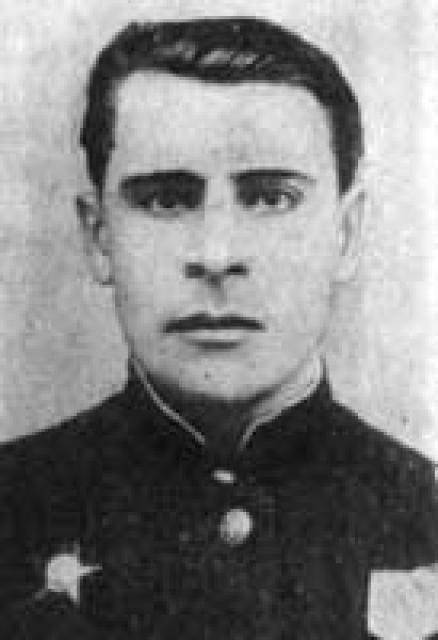
Mihail Shishenko
 Ukraine
Biography of Mikhail Shishchenko
Mikhail Shishchenko was born on February 5, 1917, in the village of Krasnodon, Voroshilovgrad region, into a family of a miner. He completed 7 grades of school in Buguraevo village, Rostov region, where he moved with his parents. In 1932, he joined the Komsomol (Young Communist League) in Buguraevo.
After finishing school, Mikhail started working at Mine No. 5 of the Buguraevo Coal Trust. He became the leader of the Komsomol cell at the mine. From 1938 to 1940, he served in the army and participated in battles against the White Finns, where he was wounded. After being demobilized, Mikhail returned to his hometown of Krasnodon and worked as a foreman and then as an assistant to the chief of Mine No. 1-5 while simultaneously leading the Komsomol organization at the mine. He was elected a member of the bureau and later an extraordinary secretary of the Krasnodon District Committee of the Komsomol.
Before the occupation, the Voroshilovgrad Regional Committee of the Komsomol left Mikhail Shishchenko for underground work behind enemy lines. In his memoirs, he wrote, "I, like other comrades, was left for underground work by the decision of the regional committee of the Komsomol. From the first days of the occupation, a dangerous and life-threatening struggle against the enemy began. We were given weapons, specific instructions, and assignments, but the Nazis arrested many Soviet activists, whose apartments were supposed to serve as safe houses. We had to create new ones. My younger brother Alexander, who was already a member of the underground organization "Young Guard," introduced me to N. Sumsky, the leader of the Krasnodon group. That's how I joined the ranks of the Young Guards."
Active Participation in the Resistance
Mikhail Shishchenko actively participated in the resistance. As a more experienced person, he helped young patriots in preparing and carrying out many operations. With his participation, a radio receiver was assembled through which the Young Guards listened to the reports of the Soviet Information Bureau, transcribed them, and distributed them among the local population. As a member of the Young Guards group, Mikhail Shishchenko sabotaged enemy communications, distributed leaflets, and conducted propaganda among workers, urging them to harm the occupiers and disrupt coal mine operations. He actively participated in hanging the flag on the building of Mine No. 5 in Krasnodon on the eve of the 25th anniversary of Soviet power.
During the days of arrests, Mikhail Shishchenko managed to evade the persecution of the Nazi executioners. In May 1943, the Voroshilovgrad Regional Committee of the Komsomol appointed him as the first secretary of the Rovenkovsky District Committee of the All-Union Leninist Young Communist League (Komsomol). In 1945, Mikhail Shishchenko joined the Communist Party. In the post-war years, he worked as the chairman of the Rovenkovsky District Trade Union of Miners, assistant to the chief of the Dzerzhinsk Mine Management, secretary of the party organization at the Almaznyansky Mine Management, and deputy head of the Frunzeugol Trust. In 1961, he graduated from the Rovenkovsky Mining Technical School.
In 1970, Mikhail T. Shishchenko was appointed deputy head of the Material and Technical Supply Department of the Donbassantlazit Combine. In his later years, he worked as an assistant to the director of the XXIII Congress of the Communist Party of the Soviet Union named mine. The residents of Rovenkov repeatedly elected him as a deputy of the City Council. He passed away on May 5, 1979, and was buried at the municipal cemetery in Rovenkov.
For the courage and fearlessness shown during the Great Patriotic War, as well as for honorable work in peacetime, Mikhail Tarasovich Shishchenko was awarded the Order of the Red Star, the Order of the October Revolution, and the Medal "Partisan of the Great Patriotic War" of the 1st degree.



