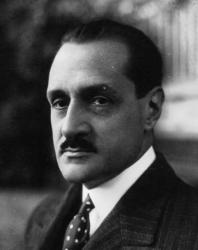
Mihail Strukov
 USA
USABiography of Mikhail Strokov
Mikhail Strokov was an engineer, aircraft designer, and co-owner of the American company 'Chase Aircraft', which specialized in manufacturing transport planes for military aviation.
Early Life and Education
Mikhail Strokov graduated from the Kiev Polytechnic Institute in 1908, specializing in the design and construction of gliders and airplanes.
Military Service
During World War I, Strokov received military training at the Military Cavalry School and served in the army as a captain. He was awarded the Order of St. George for his bravery in action against the enemy.
Emigration to the United States
In 1923, Strokov emigrated to the United States, where he initially worked on the construction of bridges, railways, and public buildings.
Founding of Chase Aircraft
In 1941, when the United States developed a program for using transport gliders in military operations, companies specializing in the design and production of such aircraft emerged. One of these companies was Chase Aircraft, founded in New York in 1943, with Strokov as its co-owner, vice-president, and chief engineer.
Design and Production of CG-18
In 1943, Chase Aircraft signed a contract with the US Air Force to design the 16-seat transport glider XCG-14, and its first flight took place in January 1945. Unlike other American military transport gliders, the XCG-14 was designed for higher flight speeds and was towed by high-speed aircraft such as the C-47 and P-38. This required a reinforced structure, particularly a thicker skin. However, the excellent aerodynamic characteristics of Strokov's high aspect ratio wing ensured that the glider had good flight performance despite its large size.
Development of CG-18 into C-122
In response to the US Air Force's request for more advanced transport gliders that could be converted into airplanes if necessary, Strokov designed the CG-18 based on the XCG-14. The CG-18 had an all-metal structure and a retractable undercarriage. It could carry 35 paratroopers or 24 wounded soldiers on stretchers in its cargo compartment. In 1946, Strokov received an order to produce 7 CG-18 gliders. By this time, he had acquired a controlling stake in Chase Aircraft and effectively became its president.
Conversion of CG-18 into C-122
By installing two Pratt & Whitney R-2000-11 air-cooled engines on the CG-18, it was transformed into the C-122 military transport aircraft. The C-122 made its first flight in November 1948 and proved to be a successful machine, capable of carrying 32 people over a distance of 1360 km.
Development of CG-20 and C-123
Soon after the development of the C-122, Strokov received an order for an aircraft with twice the payload capacity. He designed the CG-20 glider and its motorized version, the C-123. These aircraft underwent testing in the late 1940s and early 1950s and featured larger dimensions and increased weight. The cargo compartment of the CG-20/C-123 could accommodate 60 fully-armed paratroopers or heavy equipment. The C-123 was equipped with two Pratt & Whitney R-2800 radial engines and had a maximum speed of 392 km/h and a range of over 2000 km.
Later Career and Legacy
In the early 1950s, Strokov faced setbacks when his business partner, Edgar Kaiser, engaged in unethical practices that led to the cancellation of contracts for the C-123. The production of the aircraft was transferred to the Fairchild company. Despite these challenges, Strokov managed to secure compensation from his partners and continued his design work as the president and chief engineer of Chase Aircraft. He focused on improving the operational capabilities of the C-123 and developed the YC-123E, which could take off from uneven surfaces, snow, ice, and water.
Death and Recognition
Mikhail Strokov passed away in Princeton, New Jersey, at the age of 90, largely forgotten by the aviation community. His contributions to the development of transport gliders and aircraft, including the successful C-122 and C-123 models, were overshadowed by the controversy surrounding his business partners. However, his designs and principles of aircraft development continue to influence the aviation industry.