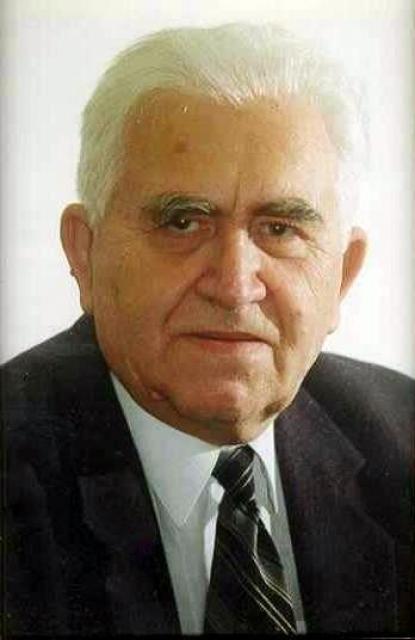
Mihail Yadrenko
 Ukraine
- Biography of Mikhail Yadrenko
- Education and Early Career
- Contributions and Achievements
- Teaching and Mentoring
Biography of Mikhail Yadrenko
Mikhail Iosifovich Yadrenko was a prominent mathematician, doctor of physical and mathematical sciences, professor, and corresponding member of the National Academy of Sciences of Ukraine. He was born on April 16, 1932, in the village of Dremaylovka, Kulikovskiy district, Chernihiv oblast. Yadrenko completed high school in Chernihiv with a gold medal.
Education and Early Career
From 1950 to 1955, he studied at the Mechanics and Mathematics Faculty of Taras Shevchenko Kyiv State University. During this time, he became interested in probability theory and published his first scientific work on random walks. His teachers, Boris Vladimirovich Gnedenko and Iosif Ilich Gikhman, greatly influenced his academic development. In 1955, Yadrenko began studying a new area of probability theory called the behavior of random functions in multiple variables, known as random fields, as a graduate student at Kyiv University. His doctoral dissertation focused on the theory of homogeneous and isotropic random fields.
After completing his graduate studies, Yadrenko joined the Department of Mathematical Analysis and Probability Theory at Kyiv University. He dedicated much of his time and energy to the development of school mathematics education, organizing mathematical Olympiads for schoolchildren, publishing textbooks on elementary mathematics and combinatorics, and compilations of Olympiad problems. During this time, the Department of Probability Theory and Mathematical Statistics was established at the Mechanics and Mathematics Faculty of Kyiv University. After the departure of its founder and first head, Iosif Ilich Gikhman, Yadrenko became the head of the department. Under his leadership for over thirty-two years, the department conducted research in the field of random fields, asymptotic methods of probability theory, stochastic differential equations, and applied probability and statistical problems.
Contributions and Achievements
Yadrenko's initiative led to the publication of the journal "Theory of Probability and Mathematical Statistics" in 1970, which played a crucial role in the development of the Kyiv School of Probability Theory. Since 1974, the American Mathematical Society has published a full translation of this journal in English. In 1968, Yadrenko founded the periodic popular science collection "In the World of Mathematics." In 1995, this collection was transformed into a popular science, methodological, and historical-mathematical journal for all mathematics enthusiasts, from schoolchildren to professional mathematicians. Yadrenko served as the editor-in-chief of this journal since 1970.
Yadrenko's scientific legacy consists of over 200 publications. His monograph, "Spectral Theory of Random Fields" (1980), became a fundamental reference for specialists in the field of random fields. This book was reprinted in the United States in English. Together with A. M. Yaglom, Yadrenko is considered one of the founders of spectral theory of random fields. This theory allows the representation of random fields with correlation functions invariant under certain transformation groups as series or stochastic integrals with orthogonal values. It is closely related to the theory of group representation, orthogonal functions, and positive-definite kernels. Yadrenko developed spectral theory for homogeneous and isotropic fields in Euclidean and Hilbert spaces, on the sphere, as well as in Lobachevskian space. These works have important applications in physics and statistics.
In the late 1950s, Yadrenko began studying fields that are extensions of one-dimensional Markov processes. His works showed the degeneracy of the class of ordinary homogeneous isotropic Markov fields (all such fields are random constants). These results had a significant scientific impact and led to the formation of a new scientific direction related to the generalization of the concept of a Markov field. Yadrenko obtained several significant results on the local properties of sample functions of random fields, such as continuity, analyticity, and quasi-analyticity. He established a range of necessary and sufficient conditions for absolute continuity and singularity of measures generated by Gaussian random fields.
Yadrenko's spectral theory enabled him and his students to develop effective methods for solving problems in the statistics of random fields, such as extrapolation, filtering, interpolation, and regression coefficient estimation.
He also showed interest in applying probability theory to various fields. His research included quality control of products, optimal methods of prevention, statistical modeling of noise in semiconductors, analysis of random number generators, and statistical modeling of distributions with random intensities.
For his work on the theory of random fields, Yadrenko received the Krylov Prize (1993) and the State Prize of Ukraine (2000). In 1990, he was elected a corresponding member of the National Academy of Sciences of Ukraine.
Teaching and Mentoring
Yadrenko was an excellent educator. His courses on probability theory were known for their mathematical clarity, coherence, transparency, and depth of exposition. Many renowned Ukrainian mathematicians were introduced to probability theory through Yadrenko's lectures.
One of the best textbooks on the fundamentals of probability theory and mathematical statistics, written by Yadrenko in collaboration with I. I. Gikhman and A. V. Skorokhod, was published in 1979. A unique problem collection, created by Yadrenko in collaboration with A. V. Skorokhod, A. Ya. Dorogovtsev, and D. S. Silvestrov, was reprinted in the United States in English in 1997.
Yadrenko always took pleasure in the success of his students and created conditions for their scientific achievements. Under his guidance, 45 doctoral dissertations and 9 habilitations in physical and mathematical sciences were defended.
In the 1990s, changes in the country's economic system created a need for specialists in new professions such as financial and actuarial mathematics. In 1995, Yadrenko began lecturing on actuarial mathematics and risk theory in insurance, becoming the first in Ukraine to do so. Together with his students, he published the first textbook in Ukrainian on econometrics, financial, and actuarial mathematics. The establishment of a system for training specialists in these disciplines within the "Statistics" educational program was the goal of an international project led by Yadrenko, which was carried out from 1997 to 2001 as part of the TEMPUS-TACIS program of the European Union.
Working with schoolchildren and scouting talented young people were heartfelt needs for Yadrenko. For over 40 years, he organized mathematical Olympiads at various levels, mathematical clubs for schoolchildren and students. Since 1970, he headed the jury of the All-Ukrainian School Olympiad. He also organized a correspondence physics and mathematics Olympiad for the journal "In the World of Mathematics."
It is impossible to enumerate all of Yadrenko's public responsibilities. He was one of the two chief editors of the journal "Applied Statistics, Actuarial and Financial Mathematics," deputy editor-in-chief of the journal "Theory of Probability and Mathematical Statistics," and a member of the editorial board of the journal "Random Operators and Stochastic Equations."
Yadrenko held the title of Honored Scientist and Technician of Ukraine and was awarded the Order "For Merit" of the Third Degree and numerous medals.


