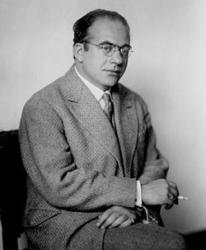
Milorad Pavic
 Serbia
- Childhood and Early Life
- Education and Inspiration
- Literary Journey
- Non-Linear Prose and Innovation
- The Khazar Dictionary
- Literary Influences
- Mount Athos and Human Nature
- Interactive and Digital Literature
- Legacy and Recognition
Childhood and Early Life
Born on October 15, 1929, in Belgrade, Serbia, Milorad Pavić was the son of a sculptor and a high school philosophy teacher who were passionate about sports. Pavić's childhood was heavily influenced by his maternal relatives who lived across the Danube River in the town of Pančevo. Their idyllic countryside home and the surrounding farmstead left a lasting impression on his young mind.
Education and Inspiration
Pavić attended Karadjordje Elementary School in Belgrade and later enrolled in the University of Belgrade's Faculty of Philosophy in 1949. He graduated in 1954 with a degree in literature. Pavić's family had a long literary lineage dating back to the 18th century. He was particularly inspired by his paternal uncle, Nikola Pavić, a renowned writer of the mid-20th century.
Literary Journey
Pavić's literary aspirations emerged early. His first stories, written in his youth, were published in a school newspaper. Influenced by his family's storytelling tradition, he developed a keen sense of oral narrative. His early works often drew upon the folktales and legends of his childhood in Pančevo.
Non-Linear Prose and Innovation
As Pavić's writing matured, he became known for his experimental and non-linear prose. He rejected traditional narrativa and instead sought to create works that reflected the fragmented and associative nature of human thought. His novels and short stories often took the form of dictionaries, water clocks, crosswords, tarot cards, or astrological guides.
The Khazar Dictionary
One of Pavić's most renowned works is "The Khazar Dictionary" (1984). Originally conceived as a student, the novel was inspired by Pavić's encounter with the Khazar mission of Saints Cyril and Methodius. It is structured as a non-linear dictionary, with entries from various characters and perspectives that form an intricate tapestry of history, mythology, and personal experience.
Literary Influences
Pavić was deeply influenced by Russian literature, particularly the works of Pushkin, Gogol, Dostoevsky, and Tolstoy. He also translated many Russian writers into Serbian. In the 21st century, he noted a surge in female writers who were shaping the literary landscape in novel ways.
Mount Athos and Human Nature
Pavić's novel "Landscape Painted with Tea" (2002) explores themes of monasticism and the duality of human nature. Set on the Greek Orthodox Mount Athos, the novel investigates the concept of idiorrhythmics (solitary monks) and cenobites (monks living in community).
Interactive and Digital Literature
Pavić embraced the digital age and experimented with interactive and non-linear forms of literature. He created works that could be read on the internet, allowing readers to navigate and engage with the text in new and immersive ways.
Legacy and Recognition
Milorad Pavić's groundbreaking contributions to literature earned him international acclaim. His works have been translated into numerous languages and have received prestigious awards. Pavić's literary innovations have influenced contemporary literature and continue to inspire writers and readers alike.