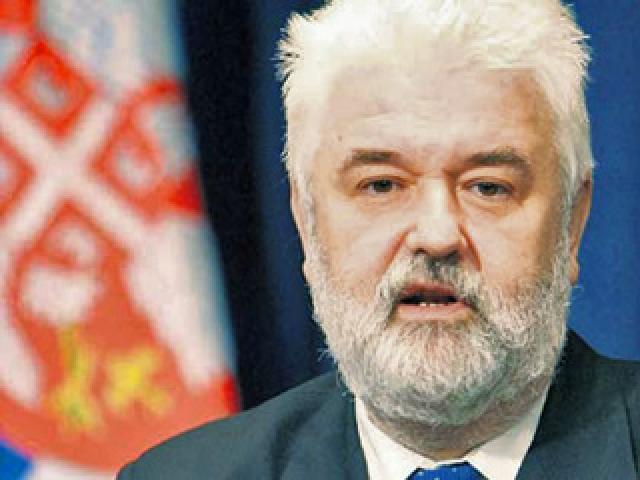
Mirko Cvetkovich
 Serbia
Biography of Mirko Cvetković
Mirko Cvetković, born on August 16, 1950, in the small town of Zaječar in eastern Serbia, is a Serbian economist, politician, and statesman. He comes from a humble family, with his father Srboljub being an economist and his mother Stana. His grandfather, a teacher, was killed by German invaders in 1941 in Kragujevac. Cvetković completed his primary and secondary education in Zaječar. He studied economics and graduated from the Faculty of Economics at the University of Belgrade with honors. He defended his candidacy dissertation and qualification work for a doctoral degree. In the 1980s, he was among the first Serbian experts to work as advisors for the World Bank. He was involved in projects in Pakistan, India, and Turkey. Cvetković worked at the Mining Institute for ten years and then at the Economic Institute for six years, followed by seven years at the consulting firm CES Mecon, where he worked as a consultant. He is the author of several scientific articles, primarily on economics and finance.

Cvetković is fluent in English and proficient in playing the piano, saxophone, and clarinet. He describes himself as a Serbian nationalist of a liberal-western orientation ("a moderate nationalist") and maintains positive relations with the leadership of the Serbian Orthodox Church. He supports liberal economic reforms and the European integration of Serbia. After the "Bulldozer Revolution," he worked as the Deputy Minister of Economy and Privatization from January 2001. He was invited to the ministry by A. Vlahović, who became the minister at that time. In this position, he had to find solutions to several acute problems.
From 2003 to 2004, he served as the Director of the Privatization Agency, where he developed a privatization program and completed its technical preparation. Supporters noted that he was entrusted with the most challenging parts of the work. After his resignation, he did not make any statements and did not participate in public life, focusing on analytical and consulting activities. In 2007, still unknown to the general public, he was appointed as the Minister of Finance of Serbia at the initiative of B. Tadić. In this position, he contributed to budget stabilization and the continued economic development of the country. This required the implementation of several unpopular measures and strict budget austerity. As a minister, he also coordinated the work of fiscal services and economic policies in the government, supervised economic and social development forecasting, state financial planning, tax, and monetary policies. On June 27, 2008, President Boris Tadić selected Cvetković as the new Prime Minister after parliamentary elections held in May.
On July 7, he was elected as the Prime Minister with the support of 127 parliament members. At the time of his appointment, he was a non-party member. The new Prime Minister of Serbia is known as a technocratic economist and, as described by "Politika," does not fit the "Balkan type of leader," being a modest, restrained individual not inclined towards rhetoric. Cvetković enjoys great authority among economists and businessmen. Therefore, many specialists believe that a head of government with such a profile is highly suitable for Serbia, where economic reforms have practically stalled in recent years. Serbian newspapers note that the appointment of an expert economist as the head of government could be a successful compromise solution capable of reconciling the interests and ambitions of the main members of the newly formed coalition.
The functioning of the new cabinet, according to Cvetković, will be based on the principles of European integration, the struggle to preserve Kosovo's autonomy as part of Serbia, strengthening the economy and social sphere, combating corruption and crime, and fulfilling international obligations. He also promised to expedite economic and other reforms stipulated in the agreement with the EU.
Cvetković's government consists of the Prime Minister, Deputy Prime Ministers, and ministers. The current government includes four deputy prime ministers and 25 ministers. The government was formed by a coalition of the Democratic Party (DS), G17+, the Socialist Party of Serbia (SPS), and minority parties. In parliament, Cvetković stated that he and his government members are committed to preserving Kosovo within Serbia: "There is full agreement among the coalition members that the new government will never recognize the independence of Kosovo."
On October 8, 2008, the UN General Assembly adopted a resolution demanding the International Court of Justice provide an opinion on the legality of the unilateral declaration of independence of Kosovo. "In this way, Serbia, being a small country, became involved in the heart of global diplomatic events," the Prime Minister pointed out. According to him, the decision of the General Assembly will, in general, reduce political tensions.
On November 27, 2008, the UN Security Council approved the replacement of the international mission in Kosovo with observers from the European Union, the "neutral" EULEX mission. This decision became possible after the UN agreed to fulfill several conditions set by Belgrade. In particular, the European mission must maintain neutrality regarding the status of Kosovo and not be guided by the Ahtisaari Plan in its actions. As part of the new economic strategy for socio-economic development, the following tasks were set: the development of private business, implementation of special programs for financial assistance to private regional enterprises, the infrastructure development of the country (construction and reconstruction of roads, medical, educational, and sports facilities). The government program focused on strengthening the principle of distributing state funds and creating equal opportunities for all social groups.
One of Cvetković's first legislative proposals as Prime Minister was related to an 18% increase in pensions. In 2008, GDP grew by 6.1% (the highest growth rate in the region), inflation was 6.9%, and the dinar exchange rate remained stable. The government identified the modernization of international highways and railways passing through Serbia as a national priority. This project requires almost two billion euros. The funds should be used to complete the section from Horgoš on the border with Hungary to Novi Sad in Vojvodina, followed by the ring road around Belgrade, the section from Dimitrovgrad on the border with Bulgaria to Niš in southern Serbia. Furthermore, work is being carried out on the most challenging section from Preševo on the border with North Macedonia to Leskovac in southern Serbia, where the road must pass through the difficult Grdelica Gorge. Regarding relations with Russia, economic ties will be promoted, such as the construction of a gas pipeline (Russia's largest investment project in the Balkans), etc. The Kremlin congratulated Cvetković on his election and emphasized the need to maintain a high level of cooperation and dialogue. Regardless of the Serbian government's composition, it will speak of the traditional friendship with the Russian people (Politika, June 28, 2008).
On September 9, 2008, the Serbian Parliament ratified an agreement on oil and gas cooperation with Russia, signed on January 25 in Moscow.
On December 21, 2008, Russians acquired 51% of shares in the Serbian company NIS (Oil Industry of Serbia), and agreements were reached on the construction of the South Stream gas pipeline section and an underground gas storage. On November 11, 2008, the Serbian government decided to initiate the procedure for filing a counter-lawsuit with the International Court of Justice against Croatia for genocide against Serbs. Cvetković's government made the decision to form a group of lawyers to establish the truth about ethnic cleansing and war crimes committed by Croatia on the country's territory during Operation Storm in 1995. Belgrade will use all the time given to it by The Hague Tribunal to present the whole truth about the responsibility of Croatian authorities for war crimes against Serbs. Croatia does not recognize the ethnic cleansing that took place on its territory, which led to 250,000 Serbs leaving the country. The Prime Minister stated that the counter-lawsuit pertains not only to the crimes committed during the aggression on the then Republic of Serbian Krajina in 1995 but also for crimes committed during the period of the pro-fascist Independent State of Croatia during World War II.


