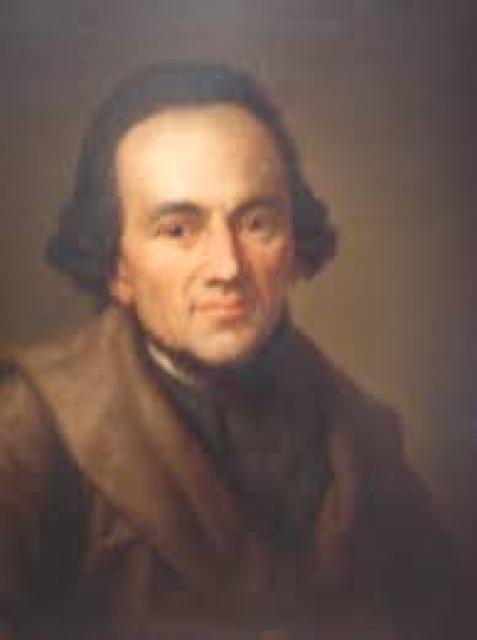
Moses Mendelssohn
 Germany
- Biography of Moses Mendelssohn
- Philosophical Works and Reputation
- Religious Views and Influences
- Enlightenment and Legacy
- Other Notable Works
Biography of Moses Mendelssohn
Early Life and InfluencesMoses Mendelssohn was born on September 6, 1729, in Dessau, Germany. Under the guidance of his father, a theologian, and Rabbi David Hirschel Frankel, he studied the foundations of Jewish religion. It was through his studies with Frankel that he became interested in philosophy, particularly the works of Maimonides.
In 1743, Mendelssohn moved to Berlin, where he immersed himself in German literature, Latin, mathematics, and philosophy, including the teachings of Leibniz, Wolff, and Locke. To support himself, he gave lessons and worked as a bookkeeper.
Philosophical Works and Reputation
In 1754, Mendelssohn forged a friendship with Lessing and other literary figures in Berlin. The following year, he published his first major work, "Philosophische Gespr che" (Philosophical Conversations), establishing his reputation as a philosopher. He also wrote "Briefe ber die Empfindungen" (Letters on the Sensations), a treatise on aesthetics, in the same year.
In 1763, Mendelssohn received the Prussian Academy of Arts' award for his essay "Abhandlung ber die Evidenz in der metaphysischen Wissenschaften" (Treatise on Evidence in Metaphysical Sciences), which was submitted in a competition with Kant. Four years later, he published his most famous work, "Ph don, oder ber die Unsterblichkeit der Seele" (Phaedo, or On the Immortality of the Soul), which explored the relationship between man and God and proposed a proof for the immortality of the human soul.
Religious Views and Influences
Despite his philosophical pursuits, Mendelssohn remained a devout Jew. He engaged in debates with Swiss theologian Lavater, who challenged him to either refute the Christian dogmas in Bonnet's writings or convert to Christianity. Mendelssohn argued that his philosophical views strengthened his religious beliefs, and he continued to hold to Judaism.
He also wrote "Jerusalem, oder ber religi se Macht und Judentum" (Jerusalem, or On Religious Power and Judaism), advocating for religious tolerance. In his "Morgenstunden" (Morning Hours), he provided a moral-theological proof for the existence of God.
Enlightenment and Legacy
Mendelssohn is often regarded as the initiator of the "Jewish Enlightenment." His essay "Was ist Aufkl rung?" (What is Enlightenment?) sparked a debate on the Enlightenment in late 18th-century Germany. He collaborated with Lessing to publish several journals.
Mendelssohn's ideas had a profound impact on the development of German Enlightenment thought and on the Reform Judaism movement in the 19th century. He died in Berlin on January 4, 1786.
Other Notable Works
Mendelssohn's other notable philosophical works include "Betrachtungen ber die Quellen und die Verbindungen der sch nen K nste und Wissenschaften" (Reflections on the Sources and Connections of the Fine Arts and Sciences) and " ber das Erhabene und Naive in den sch nen Wissenschaften" (On the Sublime and Naive in the Fine Arts).


