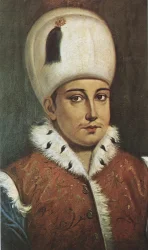
Mustafa II
Mustafa II ruled the Ottoman Empire during a turning point in its relationship with Europe. Determined to recover ground lost in years of war, he personally joined early military campaigns. But the devastating defeat at Zenta and the 1699 Treaty of Karlowitz forced the empire to accept major territorial losses. His reign ended in revolt, as discontent over court politics and government reached the capital.
An Ottoman Heir
Born in Edirne in 1664, Mustafa was the son of Sultan Mehmed IV and Gülnuş Sultan. He spent much of his early life within the imperial court, where he and his younger brother Ahmed received an education in statecraft, religion and military tradition. When Sultan Ahmed II died in 1695, Mustafa succeeded him, taking the throne at a time when the Ottoman state remained locked in a major war with the Habsburgs and their allies.
A Campaigning Sultan
Mustafa sought to present himself as an active ruler and personally led campaigns against Habsburg forces in Hungary. Early victories in 1695 and 1696 briefly raised hopes that the Ottoman position could be restored. The turning point came at the Battle of Zenta in 1697, where Prince Eugene of Savoy’s Habsburg army defeated the Ottoman forces and killed Grand Vizier Elmas Mehmed Pasha. The loss weakened the empire’s leverage and pushed the government toward peace.
Negotiations resulted in the Treaty of Karlowitz in 1699. The Ottoman Empire ceded most of Hungary and Transylvania to the Habsburgs, while Venice gained the Morea and other territories. The agreement marked a major retreat from Ottoman power in central Europe and became a defining moment in the empire’s diplomacy. In the years that followed, Grand Vizier Amcazade Hüseyin Pasha pursued administrative and financial measures to stabilize the state after the prolonged conflict.
Court at Edirne and Political Tensions
After the treaty, Mustafa increasingly favored Edirne as his residence over Istanbul. His close reliance on the scholar and statesman Feyzullah Efendi, whom he elevated to the office of şeyhülislam, drew resentment from officials and soldiers who felt shut out of influence. Tensions also reflected wider complaints about taxation, appointments and the distribution of power at court.
In 1703, troops and other opponents rose in what became known as the Edirne Incident. The revolt spread from Istanbul toward Edirne and targeted Feyzullah Efendi and the sultan’s inner circle. Faced with the crisis, Mustafa abdicated in August 1703 in favor of his brother Ahmed III.
Final Years and Legacy
Mustafa lived only a few months after losing the throne, dying in Edirne in December 1703 at the age of 39. His reign is remembered for the Treaty of Karlowitz and for the political upheaval that brought it to a close. His early campaigns reflected an effort to restore Ottoman strength, while the peace settlement and the revolt revealed the limits of military recovery and the pressures facing the imperial government.