Nadir-shah
 Iran
IranBiography of Nadir Shah
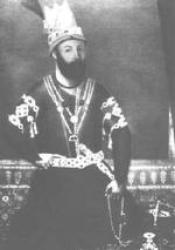
Early Life and Rise to PowerNadir Shah, the ruler of Iran from 1736, was undoubtedly a talented, brave, and intelligent military commander. He was born into the Imam-Kuli family, belonging to the Kizilbash community, known as the "redheads," who wore a cap with 12 purple stripes in honor of the 12 Shiite imams. The Afshar-Kizilbash were Turkic people, closely related to the Azerbaijani language and culture.
Nadir's father, who made a living as a sheepskin tanner, did not leave him any wealth or titles, so the ambitious young man had to achieve everything on his own. With a small group of daring comrades, he worked as a mercenary for small rulers, essentially engaging in looting. As his group grew, so did his enemies become more formidable. After an unsuccessful struggle against Mahmud of Sistan, Nadir was forced to seek an ally and, in 1725, he offered his services to Shah Tahmasp. At that time, Iran was conquered by one of the Afghan tribes, and the once powerful shah only held small territories near the Caspian Sea. This alliance was beneficial for both Shah Tahmasp and Nadir. With the help of the shah's troops, Nadir easily captured Khorasan, an historical region in northeastern Iran, and then its capital, Mashhad, the pilgrimage site for Shiite Muslims flocking to the tomb of Imam Reza. In five years, Nadir managed to restore the collapsed empire and, after expelling the Afghan-Ghilzai from the former capital, Isfahan, placed his ally on the throne as Tahmasp II.
Military Campaigns and Indian Expedition
With the support of Russian General V.Ya. Levashov, the Persians liberated the western regions of the country. However, there was still unrest in the empire. The Dagestanis were causing trouble in the north, and the Afghans were rebelling in the east. Nadir went to Khorasan to suppress another revolt, while Tahmasp II led the fight against the Turks. However, the Shah's forces were defeated, and Persia had to sign a humiliating treaty. Frustrated, Nadir hurried back to the capital and managed to overthrow the dishonorable Shah. His eight-month-old son, Abbas III, was placed on the throne, while Nadir became the de facto ruler. For nearly five years, the military campaigns nearly depleted the treasury. It was then that Nadir Khan planned an invasion of India. With the support of Iranian nobility, unlimited powers and the title of Shah, granted at the Mugan Kurultai, Nadir indulged in festivities, secretly preparing for the long expedition. Although the Great Mughal Empire was in decline, its treasury still held immense wealth, and the splendor and luxury of the court aroused envy among its neighbors.
Nadir did not immediately embark on the Indian expedition. In 1737, he led his forces to Kandahar. After besieging the city, it was captured and destroyed, and Nadir sent a letter to the Mughal Emperor, Muhammad Shah, asking him to block the retreat of the retreating Afghans, who were also enemies of India. However, not receiving a response, Nadir easily took Kabul almost without resistance, conquering the nearby tribes and strengthening his position. As the Iranians had already entered Mughal territory, the Indians tried to repel the invasion, but their every move was immediately reported to the Mughal ruler by spies. Nadir Shah did not rush and sent another letter to Muhammad Shah, assuring him of his friendly feelings and emphasizing that his only desire was to suppress the Afghans. As a skilled politician and diplomat, he gradually approached his goal step by step and, ultimately, approached Delhi with minimal losses. On March 20, 1739, during the celebrations in his honor, Nadir recognized Muhammad Shah as the sole ruler of India. It seemed that everything ended peacefully, but that was not the case: the citizens suddenly decided to resist. In response, Nadir unleashed a massacre that lasted six hours. Approximately 20,000 people were killed. The atrocities continued until Muhammad Shah convinced Nadir to stop the bloody massacre. In the following days, it was announced that the treasures and property would be confiscated. They collected a huge sum of money and precious items, amounting to about 700 million rupees. On May 12, Nadir Shah solemnly placed the Indian crown on Muhammad Shah's head, for which, according to Persian chronicles, the Great Mughal asked Nadir to take possession of a part of his country west of the Indus. After spending 57 days in Delhi, Nadir Shah embarked on his journey back, taking with him the treasures of the Mughals, including the famous Koh-i-Noor diamond ("Mountain of Light") and the magnificent Peacock Throne adorned with jewels. He also took thousands of skilled craftsmen, weapon-makers, weavers, builders, and jewelers. While still displaying friendly feelings towards Muhammad Shah, Nadir left the Mughal Empire on the brink of destruction.
Later Years and Death
Having significantly replenished the treasury, Nadir Shah used most of the valuables for personal purposes and to support his army. The ostentatious luxury of the court juxtaposed with the horrifying poverty of the common people. Over time, the Shah had to find new ways to support his enormous army, the main pillar of his policy, which meant imposing new taxes on peasants and townspeople, causing widespread discontent. Movements of impostors emerged here and there. For example, between 1743 and 1744, someone claimed to be the miraculously saved Safavid prince Sam-mirza in Shirvan. In 1744, Sefi-mirza appeared in Kars, receiving support from the Ottoman Turkey. He led a hundred thousand-strong army in an attempt to overthrow Nadir. The son of a tanner who became the ruler of a vast country had to send his army to suppress rebellions in Georgia, Armenia, Dagestan, Azerbaijan, and Baluchistan. Court disputes did not subside either. After the Indian campaign, Nadir became increasingly suspicious and cruel. Mass executions followed one after another. Some attributed this to the sorcery of Indian magicians, but most likely, it was the result of years of constant struggle, which became the main business of the Shah, nicknamed the Conqueror of the World. It was under his rule that Iran acquired not only the territories of India but also those of Central Asia and the Transcaucasus.
In 1746, a rebellion broke out in Sistan, burdened with unbearable taxes. Nadir's relative Ali Kuli Khan, sent to suppress it, suddenly switched sides and joined the rebels. Nadir himself set out on a campaign. He pitched his camp near Khwafshan (Eastern Iran) and learned about another conspiracy. However, he failed to prevent it and was assassinated in his tent.
After Nadir's death, the vast empire disintegrated into separate domains, and the powerful army turned into marauding bands.