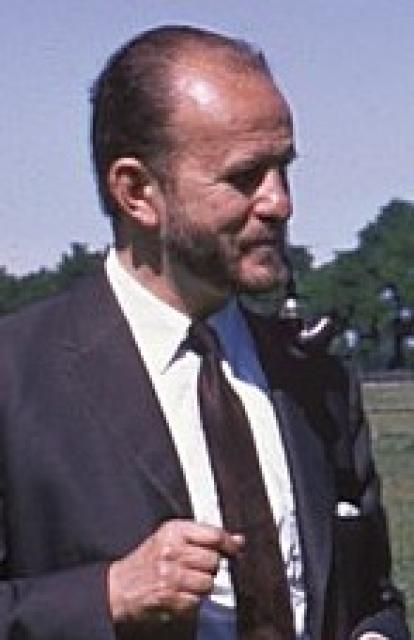
Nandor Wagner
 Hungary
- Early Life and Career
- The Hungarian Period (1945-1956)
- The Swedish Period (1956-1969)
- The Japanese Period (1970-1997)
- Legacy
Early Life and Career
Nandor Wagner was born in Oradea, Romania, on January 16, 1922. His father was a dentist. Wagner studied at the Hungarian Academy of Fine Arts in Budapest before and after World War II.
The Hungarian Period (1945-1956)
After the war, Wagner established his studio in Budapest. He created notable works such as the "Corpus Hungaricum" sculpture, a bronze piece depicting the Hungarian nation, and "Attila József," a tribute to the famous Hungarian poet. In 1955, he collaborated with architect Zoltán Farkasdi to design the "Fountain with Three Boys" for Budapest's Margitsziget Bridge, which won first prize.
The Swedish Period (1956-1969)
During the Hungarian Revolution of 1956, Wagner supported the uprising as a member of the Revolutionary Committee of Artists. After the Soviet invasion, he fled to Sweden with his family and established a studio in Lund. In this period, he began creating sculptures from stainless steel, such as the "War Memorial to Polish Soldiers" and "Four Children Fountain." Wagner also explored industrial design and ergonomics, patenting several of his ideas. At the Lund Academy of Fine Arts, he met Japanese student Chiyo Akiyama, who became his wife and lifelong companion.
The Japanese Period (1970-1997)
Wagner moved to Japan in 1970 and opened a studio in Mashiko, Tochigi Prefecture. He began working with clay, creating the "Mother and Child" in 1970. Wagner's later works in Japan included monumental sculptures, such as the two 6-meter stainless steel statues of "Dososhin" at Narita View Hotel. He also pursued watercolor painting and artistic ceramics, notably his "Silk Road" series of 32 terracotta pieces.
Legacy
Nandor Wagner and his wife Chiyo established the TAO (The Research Institute for World Culture and Development), which supported young artists. They also founded the Hungarian Academy for Humanistic Heritage in 1999. Wagner's sculptures and paintings are renowned for their expressive forms and creative use of materials. He died in Tokyo on January 23, 1997.


