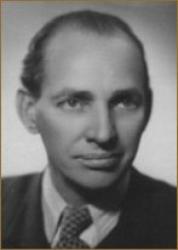
Nicolas Guillen
 Cuba
CubaBiography of Nicolás Guillén
Nicolás Guillén, a Cuban poet and recipient of the International Stalin Peace Prize (1954), was born on July 10, 1902, in Camagüey. He graduated from the University of Havana with a degree in law, but soon abandoned his legal career to work as a printer and journalist. His first poems were published in 1919, and he continued to be published in various magazines throughout the 1920s. In 1930, his first collection titled "Motivos de son" was published, followed by "Sóngoro cosongo" (1931) which depicted the lives of Cuban blacks. In his collection "West Indies, Ltd." (1934), he turned to political lyricism.
In 1936, Guillén, along with other members of the journal "Mediodía," was arrested on fabricated charges and imprisoned. The following year, he joined the Communist Party, participated in the Congress of Writers and Artists in Spain, and reported on the Civil War. During this time, he published the collection "Songs for Soldiers and Sonnets for Tourists" and the epic poem "Spain: A Poem in Four Sorrows and One Hope" (1937). Guillén returned to Cuba and was nominated as a candidate in local elections by the Communist Party. His collection "All Songs" (1947) was dedicated to the revolutionary movement in Cuba and other Latin American countries.
In the following years, Guillén traveled extensively throughout South America, Europe (including France and Finland), China, and Mongolia. In Helsinki, he met Alain Robbe-Grillet, a representative of the French "new novel" movement. Guillén was denied entry to the United States in 1953 and was also prohibited from returning to Cuba, where he could only return after the revolution's victory.
In 1958, he published the collection of poems "The Whole Nation's Pigeon." Upon his return to Cuba, he was appointed president of the National Union of Writers of Cuba. Guillén gained widespread recognition as a representative of "black poetry" (poesía negra), which combined European and African cultural traditions. His work involved the use of onomatopoeic techniques, imitating the sounds of drums and son rhythms. He influenced the development of African themes in the poetry of Venezuela, Puerto Rico, the Dominican Republic, as well as literature in Portuguese-speaking African countries such as Angola, Mozambique, São Tomé and Príncipe. Miguel de Unamuno praised his poetry, and Federico García Lorca wrote a "Cuban Negroes' Song" influenced by Guillén's work. Guillén also met Lorca, and it was his speech that opened the first congress of the Union of Cuban Writers. The African-American poet Langston Hughes also highly praised Guillén's Cuban "song" and had a meeting with him.
Guillén was friends with Gabriel García Márquez, Jorge Amado, and the Venezuelan writer Miguel Otero Silva. It was Guillén who introduced the young journalist Márquez to the leader of the rebels, Fidel Castro, at a time when the communists did not yet support Castro. Guillén was honored with the title of "national poet" in Cuba during his lifetime, previously held only by José Martí. African-centric ideologist Molefi Kete Asante in the United States called for the study of Guillén's poetry in addition to well-known poets such as Keats, Yeats, Twain, Wordsworth, Frost, Eliot, and Goethe.
The famous composition "Sensemayá" by Silvestre Revueltas was based on Guillén's poem of the same name. In the Soviet Union, Sergei Cortez composed music based on Guillén's poetry. Among the translators of Guillén's work into Russian were Alexey Surkov, Ilya Ehrenburg, Mark Samaev, Ovadii Savich, Pavel Grushko, and Inna Tynyanova. In Belarusian, his work was translated by Ryhor Borodulin and Mikhas Streltsov, and in Ukrainian by Serhiy Borshchevsky, Mykhailo Moskalenko, Mykhailo Litvinets, and Hryhorii Latnyk. The Greek poet Yannis Ritsos translated Guillén's work into modern Greek.