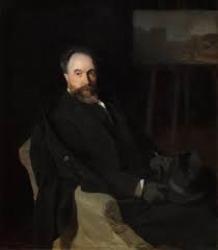
Nicolas-Louis Cabat
 France
- Early Life and Artistic Training
- Intimate Landscapes
- Idealistic Period
- Return to Realism
- French Academy and Legacy
Early Life and Artistic Training
Gustave Courbet was born in Ornans, France, on June 10, 1819. He received artistic training under the guidance of Camille Fleury and initially depicted the scenes surrounding his hometown, striving to accurately capture not only the details but also the overall mood of nature.
Intimate Landscapes
Courbet, along with his contemporaries Jules Dupré and Constant Troyon, was a founder of the "intimate landscape" movement in France. This genre of works included paintings such as "The Pool of the Villa d'Avray" (1834), "Autumn Evening" (housed in the Luxembourg Museum), "Winter Day" (1836), "The Duck Pond," and "The Plain in Arques."
Idealistic Period
In the late 1830s, Courbet traveled to Italy, where he shifted towards depicting idealized scenes, often drawing from biblical themes. Works belonging to this phase include "Street Scene in the Valley of Narni," "The Young Tobias and the Angel," "Lake Nemea," "The Disciples at Emmaus," and others.
Return to Realism
The idealistic style did not always come naturally to Courbet, and he eventually returned to his original themes in 1860. Notable paintings from this period include "Banks of the Seine near Croissy," "Stream in the Forest" (1864), "Young Copse at Champelau," and "The Storm."
French Academy and Legacy
From 1879 to 1884, Courbet served as director of the French Academy in Rome. Among his students was Paul Alfred de Curzon. Courbet's influence on later generations of artists cannot be overstated, as he played a pivotal role in the development of Realism and its impact on modern art.