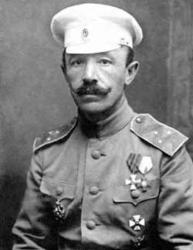
Nikolay Demidov
- General Ivan Ivanovich Demidov
- Early Military Career
- Military Service in the Napoleonic Wars
- Later Career and Death
General Ivan Ivanovich Demidov
General Ivan Ivanovich Demidov, an esteemed general of infantry, adjutant general, and senator, belonged to the renowned Demidov family of industrialists. Born on August 19, 1773, in the luxurious estate of Gorokhovsky Lane, Moscow, he was the son of Brigadier Ivan Ivanovich Demidov and Elizaveta Grigoryevna Teplova, the daughter of Senator Grigory Teplov.
Early Military Career
Following the custom of that time, Ivan Demidov was enrolled in the elite Preobrazhensky Life Guards Regiment at birth, being promoted to sergeant three years later. He entered active service as a second lieutenant on January 1, 1790, and rose through the ranks rapidly, becoming a captain in 1798 and a colonel in 1799. In 1803, he was promoted to major general and assigned to the Izmaylovsky Life Guards Regiment, while also being appointed the Chief of the Petrovsky Infantry Regiment from May 16 of that year.
Military Service in the Napoleonic Wars
In early 1807, during the Russo-French War, Major General Demidov and the Petrovsky Infantry Regiment were stationed in Prussia, but did not engage in combat. He was involved in the formation of the Libau Infantry Regiment that same year. In 1808, Demidov joined the army operating in Finland against the Swedes, where he was tasked with guarding the town of Vaasa with two infantry battalions and two Cossack squadrons.
On June 13, Demidov was deceived by rumors of a large enemy detachment advancing towards the village of Sembdi and marched to meet them with almost all his forces. Meanwhile, the Swedes, led by Adjutant General Bergenstrole, arrived in Vaasa by ship from Umeå and captured the town. Upon realizing his mistake, Major General Demidov returned and stormed Vaasa, suffering losses of approximately 150 killed and wounded. The Swedes lost a cannon, the commander of the landing force, 12 officers, and 235 non-commissioned officers as prisoners, with up to 300 killed and wounded.
For his heroic actions, Demidov was awarded the Order of St. George, 3rd class, on July 5, 1808, "In recognition of the outstanding courage and bravery shown in the battle on June 13 against the Swedish landing forces at the city of Vaasa, where, commanding a detachment of troops, he engaged the enemy in a fierce battle that lasted six hours, and through exceptional skill and bravery of the entrusted troops, overcame the enemy's superior forces and achieved a complete victory."
Demidov went on to distinguish himself in the battles at Kuortane Kirk on August 30 and Oravais on September 2, for which he was awarded the Order of St. Vladimir, 3rd class. In early 1809, by direct order of Emperor Alexander I, he was entrusted with the defense of the Åland Islands. On December 12 of that year, Demidov was appointed Commander of the 21st Infantry Division in Finland, where he served until October 1817, when he took command of the 1st Grenadier Division. He remained as the Chief of the Petrovsky Regiment until September 1, 1814, and was promoted to lieutenant general in 1816.
Later Career and Death
In 1824, Nikolai Ivanovich Demidov was relieved from active service due to illness, as per his request. On December 15, 1825, the day after Emperor Nicholas I ascended to the throne, Lieutenant General Demidov was appointed an adjutant general, followed by a position as a Senator in the Ruling Senate in 1826.
In January-February 1826, he conducted an inspection tour of Zhytomyr and Kiev in response to the Chernihiv Infantry Regiment's rebellion and to investigate secret societies. In May of that year, Demidov was entrusted, by Imperial decree, with the inspection of the military settlement district of the grenadier regiments belonging to King Frederick William III of Prussia and Count Alexei Arakcheyev.
During the coronation of Emperor Nicholas I, N. I. Demidov commanded a detachment of infantry from the Guards Corps in Moscow.
On December 14, 1826, Demidov was appointed a member of the committee for drafting military regulations and the Director-in-Chief of the Page Corps, all cadet corps, the Dvoryansky Regiment, the Imperial Military Orphanage, and the Imperial Tsarskoye Selo Lyceum, including the Noble Boarding School, which was part of it at the time. He was also made a member of the Council on Military Schools.
As the Chief Director of the Page Corps and cadet corps, Grand Duke Constantine Pavlovich resided in Warsaw throughout this period, leaving Demidov in complete control of the military education institutions until 1831. Following the Decembrist Uprising, Emperor Nicholas I ordered stricter discipline, and Demidov implemented these measures in a peculiar manner. He placed significant emphasis on the cadets' military bearing and achieved great success in this area.
Demidov, in his own way, also showed concern for the moral education of the "young charges" entrusted to him, as he called the cadets. He understood "morality" as "good manners," consisting of "submissiveness," "obedience," and "politeness." Demidov ordered his instructions on moral education, contained in numerous orders, circulars, and similar documents, to be bound into special notebooks and distributed to companies "for the perpetual reading and instruction of cadets." He also ordered that these instructions be read aloud to the cadets by the corps officers.
At the same time, Demidov was known for his extreme piety, hypocrisy, superstition, and harshness towards wrongdoers. N. S. Leskov, in his short story "The Cadet Monastery," portrayed Demidov in a very unflattering light.
In 1828, Demidov was promoted to general of infantry. He commanded the troops remaining in Saint Petersburg in 1828, 1829, and early 1830 after the Imperial Guard marched against the Ottoman Empire. In 1828, he was awarded the Badge of Distinction for Flawless Service for XXX Years, and he also held the Order of St. Alexander Nevsky.
In 1832, Nikolai Ivanovich Demidov traveled to the Caucasian Mineral Waters for treatment of his illness, where he died on June 4 (16), 1833.