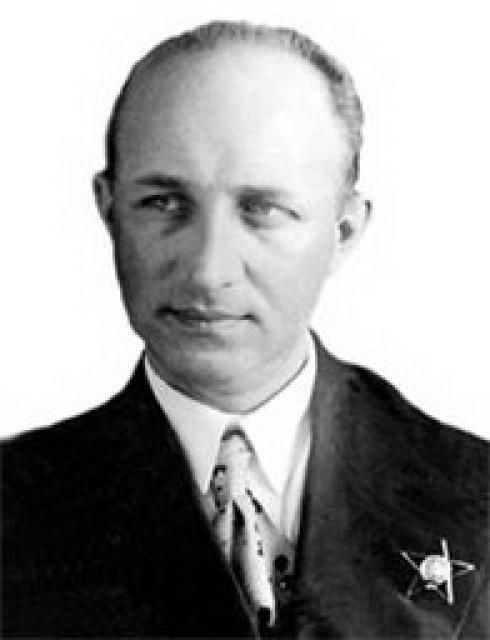
Nikolay Kucherenko
- Early Life and Education
- Career at KhPZ and Uralvagonzavod
- Post-War Career and Recognition
- Family
- Awards and Honors
- - Order of Lenin
Early Life and Education
Nikolai Alekseyevich Kucherenko was born on December 24, 1907 (January 6, 1908, by the New Style) in Lozovaya, Ukraine. His father, Alexei Markovich Kucherenko, was a locomotive driver, and his mother, Anna Fyodorovna Kucherenko, dedicated herself to raising her family.
During his summer vacations, Kucherenko gained practical experience working as a carpenter, foundryman, blacksmith, turner, fireman, and assistant to a locomotive driver. In July 1930, he graduated from the Kharkiv Institute of Transport Engineers (now Kharkiv State Academy of Railway Transport).
Career at KhPZ and Uralvagonzavod
After completing his studies, Kucherenko began working as a draftsman at KhPZ (Kharkov Locomotive Plant). In 1936, the plant's tank production was renamed "Factory No. 183." Kucherenko moved to the tank design bureau that year.
From 1934 to 1937, Kucherenko served as the deputy head of the SKB (design bureau). He became the head of KB-100 in 1938 and 1939, and the deputy head of KB-520 from 1939 to 1940. Finally, from 1940 to 1947, he led KB-520 as its head and as deputy chief designer of Factory No. 183, which was evacuated to Nizhny Tagil during the war and reestablished at Uralvagonzavod.
Kucherenko played a vital role in improving the production process of the T-24 tank and the development of the BT-2, BT-5, BT-7, and BT-7M light wheel-tracked tanks. Collaborating with M.I. Koshkin and A.A. Morozov, he participated in the creation of the A-20 and A-32 experimental tanks, as well as the T-34 medium tank, which was accepted into service on December 19, 1939.
During and after World War II, Kucherenko continued to work at Uralvagonzavod in Nizhny Tagil as the head of KB-520 and deputy chief designer of the plant. He supervised the modernization of the T-34, contributed to the development of the T-44 tank, and led the design of several other experimental prototypes. In 1942, he became a member of the Communist Party.
Post-War Career and Recognition
From 1947 to 1949, Kucherenko served as the chief designer of the Main Administration of the Ministry of Transport Machine Building of the USSR in Moscow. He was promoted to the rank of Engineering Colonel in 1946.
In 1949, he became the chief engineer of Uralvagonzavod. From 1952 to 1967, he held various leadership positions, including head of the main administration of tank production for the Ministry of Transport Machine Building, which was later reorganized into the Committee on Defense Industry and subsequently into the Ministry of Defense Industry. He was also chairman of the state examination commission at the Bauman Moscow State Technical University and chief editor of the magazine "Bulletin of the Tank Industry."
In the 1960s, under Kucherenko's guidance, a self-propelled trolley was designed, which later served as the basis for the "Lunokhod" lunar rover.
Nikolai Alekseyevich Kucherenko passed away on September 12, 1976, and was laid to rest at Novodevichy Cemetery in Moscow.
Family
Kucherenko was married and had a daughter, Larisa Nikolaevna Vasilyeva (1935-2018), who became a poet, writer, and public figure. She founded the "History of the T-34 Tank" museum. Kucherenko's brother, Vladimir Alekseyevich Kucherenko, was a government official.
Awards and Honors
Kucherenko received numerous awards and honors, including:- Three Stalin Prizes (1942, 1946, 1948) for his contributions to tank design
- Order of Lenin
- Order of the Patriotic War, 1st class- Two Orders of the Red Banner of Labour
- Two Orders of the Red Star



