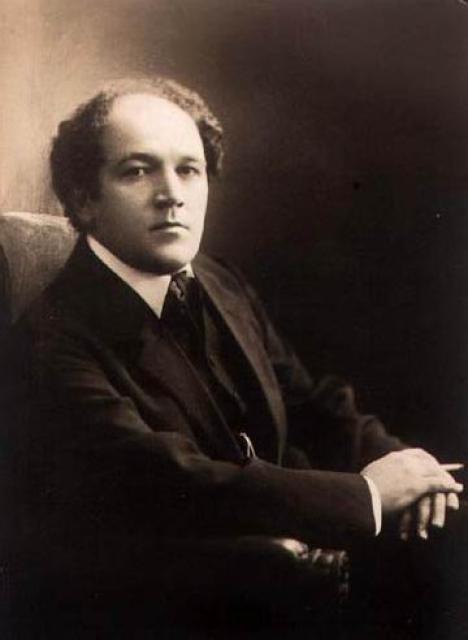
Nikolay Metner
 Russia
- Nikolai Karlovich Medtner: A Musical Titan
- The Evolution of a Musician
- An Artistic Creed
- Teaching and Creative Peak
- Friendship with Rachmaninoff
- Trials During and After World War I
- Post-Revolutionary Emigration
- Life in Exile
- Final Years and Legacy
Nikolai Karlovich Medtner: A Musical Titan
Early Life and EducationNikolai Karlovich Medtner was born on December 24, 1879 (January 5, 1880) in Moscow, Russia, to Karl Petrovich and Alexandra Karlovna Medtner. His father was an avid philosopher and poet, while his mother had been a singer in her youth. From the age of six, Nikolai began piano lessons. By observing his brother Alexander play the violin, he learned to play the instrument himself. The Medtner brothers, along with their cousin Alexander Gedike, formed part of the renowned children's musical group, the A. Erarsky Orchestra.
Medtner refused to play juvenile works, preferring instead to focus on the compositions of Bach, Mozart, and Scarlatti. Prepared by his uncle, Fyodor Karlovich Gedike, he entered the Moscow Conservatory in 1892. He graduated with a Gold Medal in 1900.
The Evolution of a Musician
During his conservatory years, Medtner's musical horizons expanded significantly. His passion for classical, romantic, and Russian music became evident. As a performer, he established himself as a pianist of exceptional ability, often presenting his own compositions in concerts. From 1904 onwards, Medtner's reputation extended beyond Russia into Germany, where he performed as a composer and pianist.
An Artistic Creed
Medtner's unique aesthetic vision, which he termed "retrospection," began to solidify during this period. He emphasized the importance of the classical-romantic heritage while avoiding excessive emotionalism that could detract from musical integrity. This perspective shaped his compositions and performances.
Teaching and Creative Peak
In 1909, Medtner became a piano professor at the Moscow Conservatory. However, he found pedagogy unrewarding and resigned a year later. The 1910s marked the creative zenith of his career. He composed a vast number of sonatas and initiated his iconic "Fairy Tales" cycle, establishing a novel form of piano miniatures.
Friendship with Rachmaninoff
Sergei Rachmaninoff became a close friend and mentor to Medtner in 1913. Despite their contrasting personalities, Rachmaninoff's unwavering support proved instrumental in promoting Medtner's concerts and publications.
Trials During and After World War I
The outbreak of World War I tested the family's loyalty to Russia. Despite being granted exemption from military service, Medtner faced accusations of being pro-German due to his ancestry. This deeply affected him, and his sense of patriotism grew with time.
Post-Revolutionary Emigration
In 1921, Medtner left Russia for Germany. Though his performances met with limited success, he continued to expand his concert tours, reaching France and the United States in 1924 and 1927, respectively. His triumphant return to his homeland in 1927 inspired him greatly.
Life in Exile
From 1930 to 1935, Medtner resided near Paris. He published his treatise "The Muse and Fashion" in 1935, outlining his enduring aesthetic principles. In his later years, he experienced increasing loneliness and separation from his Russian roots.
Final Years and Legacy
Despite failing health, Medtner recorded several of his works during the 1940s. He passed away in London on November 13, 1951. His widow, Anna Mikhailovna Medtner, returned to Russia in 1958, bringing with her the composer's vast archive.
Nikolai Karlovich Medtner stands as a towering figure in the annals of classical music. His distinctive compositions and profound artistic insights continue to captivate audiences and inspire generations of musicians.