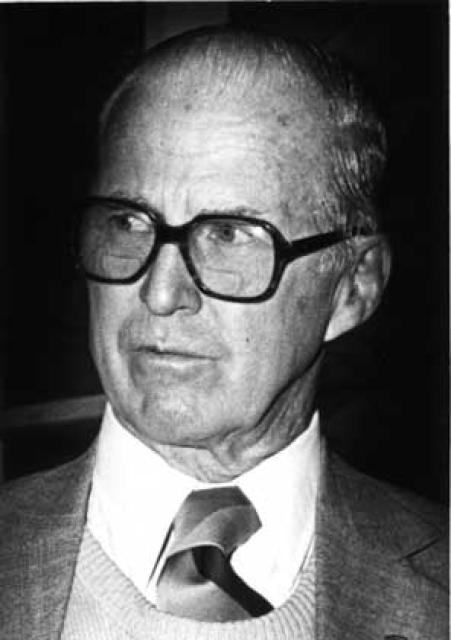
Norman Ernest Borlaug
 USA
USA- Biography of Norman Ernest Borlaug
- Education and Early Career
- The Green Revolution in Mexico
- Global Impact
- Legacy
Biography of Norman Ernest Borlaug
Norman Ernest Borlaug was an American breeder and plant pathologist, often referred to as the "father of the Green Revolution". He was awarded the Nobel Peace Prize in 1970 for his contributions to improving food security and agricultural productivity.
Education and Early Career
Borlaug completed his studies at the University of Minnesota in 1937 and went on to defend his dissertation in plant pathology in 1942. It was during his time at the university that he developed a deep interest in the issue of food self-sufficiency.
The Green Revolution in Mexico
In 1944, Borlaug moved to Mexico, where he joined a team of scientists working on solving the country's food crisis. He focused his efforts on improving wheat varieties, discovering that only four out of the numerous strains imported from different countries were resistant to rust, a devastating plant disease.
Borlaug crossbred these resistant varieties with local strains, selecting hybrids that were not only disease-resistant but also adapted to the unique climate of Mexico. The new wheat varieties he developed greatly surpassed the yields of the Mexican strains. By 1956, Mexico had achieved complete self-sufficiency in wheat production.
Global Impact
Borlaug's work in Mexico gained worldwide recognition, particularly for the Mexican wheat varieties such as Sonora 63 and Lerma Rojo. These varieties are now exported to over 20 countries and used for breeding programs in Colombia, India, Pakistan, and other nations.
Another significant achievement of Borlaug was his creation of wheat varieties that were adaptable to both winter and summer conditions. He also conducted crossbreeding experiments between distantly related plant species, aiming to combine the best qualities of the parent plants. This led to the development of a new species called triticale, which resulted from crossing wheat and rye.
Legacy
Norman Ernest Borlaug's pioneering efforts in plant breeding and agricultural research revolutionized global food production. His work not only increased crop yields but also helped alleviate hunger and poverty in many countries. His ideas and techniques continue to be influential in modern agriculture, inspiring future generations of scientists and researchers.



