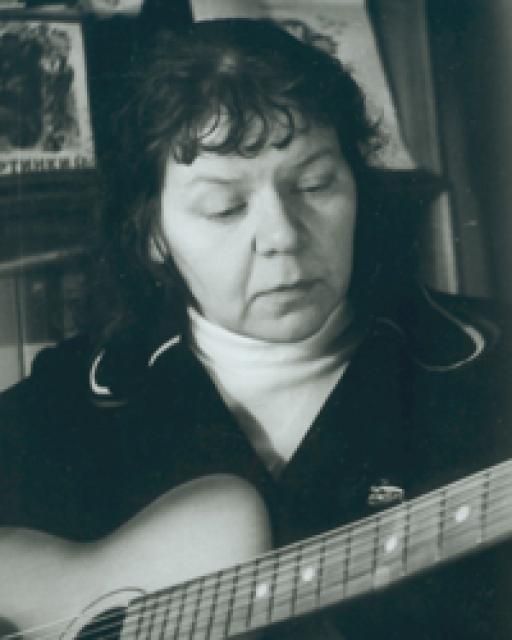
Novella Matveeva
 Russia
- Biography of Novella Matveeva
- Early Life and Inspiration from Mother
- Early Works and Recognition
- Later Works and Achievements
- Recognition and Later Career
- In 1998, Novella Matveeva was awarded the Pushkin Prize in poetry.
Biography of Novella Matveeva
Novella Matveeva is a Russian poetess, writer, bard, playwright, and literary critic. She was one of the first bards who set her poems to music and performed them with a guitar. Matveeva was born on October 7, 1934, in Tsarskoye Selo (now the city of Pushkin) in the Leningrad Oblast. Her father, Nikolay Matveev-Bodry, was a historian and geographer of the Far East and a member of the All-Union Geographical Society. Her mother, Nadezhda Matveeva-Orlenova, was a poet. Her husband, Ivan Kiuru (1934-1992), was also a poet.
Early Life and Inspiration from Mother
From 1950 to 1957, Novella Matveeva worked in a children's home in the Shchelkovo district of the Moscow Oblast. She began writing under the influence of her mother, Nadezhda Matveeva-Orlenova, who had a great love for poetry and recited verses beautifully. It was from her mother that Novella first heard the poems of Pushkin, recited in her remarkable declamation. Although their home did not always have a radio, music was constantly present thanks to her mother, who had a bell-like voice and sang gypsy, Russian, and Italian songs. Novella Matveeva comes from a famous literary family of the Russian Far East. Her grandfather, Nikolay Petrovich Matveev-Amursky, was a poet and the author of the first "History of the city of Vladivostok". Her mother, younger brother Roald Nikolaevich, uncle Veniamin Nikolaevich, and husband were also poets.
Early Works and Recognition
Novella Matveeva composed her first poems as a child during the war when she was being treated for acute avitaminosis in a hospital. She showed her poems to her father, who worked as a political officer in the same hospital. Her first publication in 1957 was a parody of the song "Five Minutes" from the movie "Carnival Night". Soon after, her poems were published in the newspaper "Sovetskaya Chukotka" (1958) and the magazine "Enisey". From 1959, her poems began to be regularly printed in central newspapers and magazines. Poets Igor Grudev and David Kugultinov, as well as employees of the Komsomol Central Committee, Viktor Bushin and Len Karpinsky, helped promote Novella Matveeva's first major collections of poems. Later, she received support from well-known poets and writers such as Samuil Marshak, Korney Chukovsky, Mikhail Atabekyan, Valentin Chivilikhin, Nikolay Starshinov, Boris Slutsky, and Yuri Voronov. When Korney Chukovsky heard her poem "The Sunny Bunny", he jumped with joy over a chair. Novella Matveeva had a successful creative career. She was noticed and loved from the beginning. A girl from the province with a mesmerizing voice and a guitar in her hands conquered the capital in the early 1960s and then the whole country. Her songs, which spread through amateur tape recorders, quickly became an album titled "Songs" (Moscow: Melodiya, 1966). It was the first bard album in the Soviet Union and has remained a rarity.
Later Works and Achievements
Starting from 1972, Novella Matveeva began composing songs using the poetry of Ivan Kiuru. Some of her most famous and popular songs include "The Mule Driver's Song" ("Oh, how long, long we travel..."), "The Wind" ("Such a strong wind..."), "Downspouts" ("Rain, evening rain..."), "The Girl from the Tavern" ("You were afraid of my love in vain..."), "Outskirts" ("It was a summer night..."), "Moustache-less Captains" ("In front of me lies the blue sea..."), "Dolphin Country" ("Blue waves come rolling..."), "Magician" ("Oh, you magician..."), "Gypsy" ("Merry gypsies strolled in Moldova..."), "Organ-Grinder" ("The snow was falling on the ground..."), and more. In 1962, Novella Matveeva graduated from the Higher Literary Courses at the A.M. Gorky Literary Institute and became a professional writer. In 1961, she was accepted into the Union of Soviet Writers.
Novella Matveeva's poetry is predominantly lyrical and romantic. She reflects on the high humanistic feelings of people, their dreams and fantasies, and the colorful world of nature that surrounds them. She also writes extensively for children. In addition, Novella Matveeva works as a translator, writes parodies and epigrams, and contributes articles on literature and art. She has authored more than 30 books of poetry, prose, and translations, including "Lyrics" (1961), "The Little Boat" (1963), "The Soul of Things" (1966), "The Sunny Bunny" (1966), "Swallow School" (1973), "River" (1978), "The Law of Songs" (1983), "Coastal Country" (1983), "Rabbit Village" (1984), "Selected Works" (1986), "Praise of Work" (1987), "Indissoluble Circle" (1991), "Melody for the Guitar" (1998), "Cassette of Dreams" (1998), "Sonnets" (1998), "Caravan" (2000), and "Jasmine" (2001).
Recognition and Later Career
As a performer, Novella Matveeva has recorded albums such as "Songs" (Melodiya, 1967), "Poems and Songs" (Melodiya, 1966), "The Road is My Home" (Melodiya, 1982), "Music of Light" (in collaboration with Ivan Kiuru, Melodiya, 1984), "Ballads" (in collaboration with Ivan Kiuru, Melodiya, 1985), "My Little Raven" (in collaboration with Ivan Kiuru, Melodiya, 1986), "Red-Haired Girl" (in collaboration with Ivan Kiuru, Melodiya, 1986), and CDs such as "What a Strong Wind" (ASP, 1997), "The Girl from the Tavern" (ASP, 1997), "Novella Matveeva" (Moroz Records, 1999), "Best Songs" (Moskovskie Okna, 2000), "Desperate Mary", and "Traktir 'Chetverenki'".
In 1984, her play "The Prediction of Eglya" - a free fantasy based on the works of Aleksandr Grin containing 33 original songs - was staged at the Central Children's Theater in Moscow.
Novella Matveeva's works have been published in hundreds of periodicals, and more than a hundred articles by famous poets, writers, critics, and literary scholars have been dedicated to her creative work. Some of the authors include Yevgeny Yevtushenko, Lev Anninsky, Yevgeny Vinokurov, Vladimir Ognev, Zoya Paperney, Valentin Lakshin, Samuil Marshak, Sergey Chuprinin, Grigory Krasnikov, Bulat Okudzhava, Evgenia Kamburova, Daniil Granin, Yakov Smelyakov, Valentin Tsibin, Boris Slutsky, Vladimir Berestov, Anatoly Urban, and Yury Smelkov.
Despite personal hardships and occasional misunderstandings from critics, art critics, editors, and publishers, Novella Matveeva's determination remains unbroken. She continues to work actively, bringing joy to her numerous fans.


