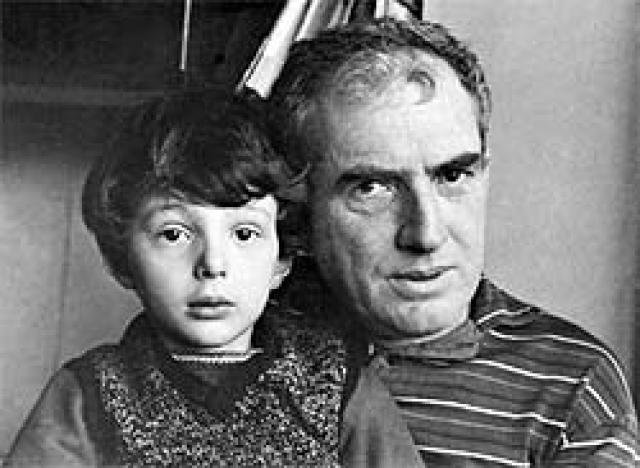
Alexandr Tsubylevskiy
 Georgia
- Alexander Tsibulevsky: A Russian-Georgian Poet
- Early Life
- Friendship with Bulat Okudzhava
- Poetic Talent
Alexander Tsibulevsky: A Russian-Georgian Poet
Alexander Tsibulevsky was a remarkable Russian-Georgian poet. He gained legendary status for his contributions to the film "Underground" by Emir Kusturica, which depicted the bloody collapse of Yugoslavia. The film portrayed Yugoslavia as a country of ideological freedom and economic development, particularly appealing to Soviet tourists. However, after the death of Marshal Tito, the diverse Balkan state he had created began to disintegrate. In the film's final scene, the citizens of former Yugoslavia, who had killed each other in civil wars, gather around a festive table, toasting and embracing one another as a sign of forgiveness. However, the land beneath their feet crumbles, and they are swept away by the river of oblivion. It was a belated repentance. The collapse of the Soviet Union was also painful, impacting many mixed families who had previously lived in unity and became like foreigners to one another. Fortunately, we still maintain good relations with some of our former republics. Unfortunately, this is not the case with Georgia, which has descended into war, despite the seemingly unbreakable traditions of brotherhood, including poetic traditions, dating back to Pushkin, Griboedov, Mayakovsky, Yesenin, and Pasternak. Today, I fondly remember one lesser-known but legendary Russian-Georgian poet - Alexander Tsibulevsky.
Early Life
Alexander Tsibulevsky was born in Rostov but was taken to Tbilisi at the age of two, which he considered his spiritual homeland. He was known as Shura by everyone. As the years passed, he aged and hunched over, but his eyes remained youthful, curious, and trusting, although he knew that trust could come at a high price. I met Shura in Tbilisi in the mid-1950s, shortly after he was released from Rustavi, where he had spent eight years for not reporting on an underground student group called "Death to Beria" (investigators decided not to include this seditious name in the case and replaced it with the neutral "Young Georgia"). Shura's gentle nature made it impossible for him to be a serious underground activist. It seemed that he simply adored a very sweet and independent girl, also an idealist named Ella Markman, who dreamed of saving the achievements of the revolution from bureaucrats. Friends called her Komunella.
Friendship with Bulat Okudzhava
In old Tbilisi, in the Sololaki district, there was a street named after Peter the Great. Bulat Okudzhava lived on this street, but the most famous resident was not him, but the "king of the streets" Chabua Amirejibi - a true prince from an ancient family rumored to be descended from the Great Mouravi. However, his noble lineage did not save him from a 25-year sentence for involvement in another underground group called "White Eagle." Chabua escaped several times, became the director of a factory in Belarus under false documents, was arrested again, and finally rehabilitated. After his novel "Data Tutashkhia," he became a national classic. The author's adventures surpassed those of the hero of his novel, the Caucasian Robin Hood. Bulat, who returned from the front after being wounded, became close with Shura when they were studying at the philological faculty. Shura, with friendly ruthlessness, criticized Bulat's first poems, immediately recognizing talent and insufficient knowledge of Russian poetry - both classical and contemporary. He read him other people's poems, with which he himself was filled, and introduced him to the literary group "Solomennaya lampa." Bulat went to Russia, published an unsuccessful book, but eventually found himself in songs. Several years later, in love and happiness, he came to Tbilisi with his wife Olya Artsimovich.
Poetic Talent
There is a line in one of Bulat's best songs dedicated to Shura - "You can't turn the past back and there's nothing to be sad about..." There are lines there that may have been inspired by their youthful conversations: "And yet, it's a shame that idols still appear in our dreams, and we still consider ourselves serfs." "And yet, it's a pity - sometimes over our victories, pedestals arise that are higher than the victories themselves." In my opinion, this song has an echo in one of Shura's poems. In Okudzhava's song it says, "Now we don't have to feel our way through the streets," and in Shura's poem it says, "When dawn breaks through the shutters - thin, you get up and feel the tender world, but deeper it's scary to look. Who is a genius will understand eternity in this. But it is certain that Tsibulevsky had breakthrough moments of genius. For example:
"But the word that has come undone
Is full of another movement:
It greets unhappiness
And only hurts with joy."
Once, with unexpected explosiveness, he said to me, "You know, there is more socialism in Mandelstam than in all those who tormented Mandelstam," and suddenly burst into tears. He longed for the poets with whom he had been denied the opportunity to embrace.
Alexander Tsibulevsky was a talented photographer who captured his beloved Tbilisi in his photographs. He held exhibitions and even wrote a literary study on Russian translations of Vazha-Pshavela's poems, whom he adored. The potential genius of Tsibulevsky, which was not fully realized, shines through in his article about Alexander Blok titled "The Living Precision of Secrets..." where he offers a remarkable insight into Blok's poetic magic: "It seems that there is nothing clearer than Blok's poems. They are created according to the law of ultimate clarity and simplicity, and yet, in this clarity, there is a mystery that, even when revealed, remains a mystery. There is nothing in common with revealing a magic trick. The mystery here is connected with the hidden... It may happen that the more the mystery is revealed, the more it remains a mystery..."
He translated the works of Galaktion Tabidze, a highly skilled Georgian poet, into Russian. For example:
"Like a boatman on an old pier...
Soul to soul, hand to hand...
I recognized you immediately, my beginnings,
River and boat, boat and river."
He also translated the poems of his contemporary, Maurice Potskhishvili, adopting him in Russian:
"The last poem
My own - not for anyone to snatch!
Like a soldier, leaving a bullet
For himself...
And my sun - a hymn -
Fades into darkness, lovingly.
The last poem -
The last bullet - in itself."
A poet who so naturally and genuinely embraces another life, another language, deserves to be embraced himself in the grateful memory, not only of his own people but also of another nation that also became his own.