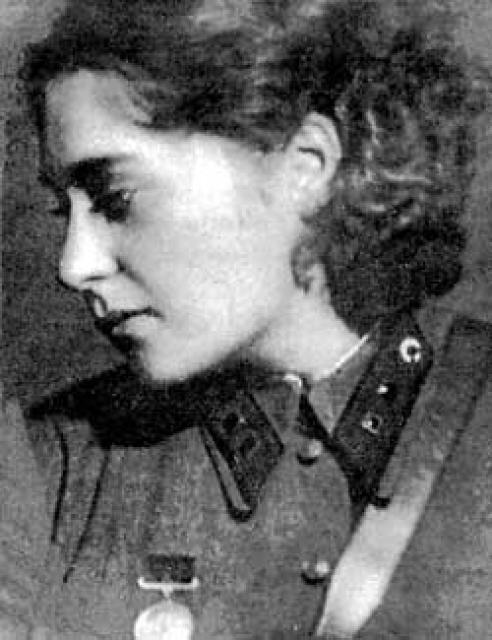
Olga Kojuhova
 Russia
Olga Kozhukhova carried the war into her writing because it had first carried her into adulthood. A young woman from Voronezh who had planned to study literature, she instead went to the front in 1941, serving as a nurse through the battles around Moscow and advancing west with the Soviet Army. After the war, she became a prose writer and poet whose fiction returned to the people, losses, and moral choices she had witnessed.
Childhood and First Writing
Olga Konstantinovna Kozhukhova was born in Voronezh on June 20, 1922, into a family of agronomists. Her father’s work took the family to Kamennaya Step, an agricultural research settlement in the open steppe. The landscape and her father’s scientific curiosity became lasting parts of her imagination. She later recalled the fields and country roads as a source of deep belonging, and wrote that books had been a constant presence at home.
Kozhukhova began publishing while still young. Her poems appeared in newspapers and in the almanac Literary Voronezh from the late 1930s. She completed secondary school in 1941 with a gold medal and was admitted to the philology faculty at Voronezh University. The German invasion changed her plans. Rather than begin university, she enrolled in nursing courses and volunteered for the front.
At the Front
Kozhukhova served as a nurse in the 418th Separate Medical Battalion. During the Battle of Moscow, her unit was attached to the 329th Rifle Division. Her wartime diary describes exhausting marches, bitter cold, air attacks, retreat through deep snow, and the fear of being encircled. In early 1942, her medical unit was caught in the dangerous fighting around Vyazma; only a small number of those trapped managed to escape.
She continued serving in military medical units and later worked as a political officer in a hospital for lightly wounded soldiers. After completing junior-lieutenant training, she joined the staff of the army newspaper For the Just Cause. She reached Berlin by the end of the war. The experience was physically costly: she suffered several concussions and a facial wound, and received the Order of the Red Star, the Order of the Patriotic War, and other decorations.
Writing After the War
After demobilization, Kozhukhova returned to a devastated Voronezh. Her first collection, White Stone, appeared there in 1945 and gathered poems that had first been printed in army and frontline newspapers. She then entered the Maxim Gorky Literature Institute in Moscow, graduating in 1950. Initially she expected to continue writing poetry, but she became dissatisfied with the form and began turning her own wartime experience into prose. Writer Konstantin Paustovsky took her into his seminar, a formative influence on her development as a prose author.
Her fiction repeatedly examined women’s experiences in war, especially the responsibility of caring for another person amid fear, exhaustion, and loss. The novel Early Snow, about frontline nurses, became one of her best-known works. Other books included The Bread You Share, My Day, My Age, The Honey Clover, For Two Deaths There Is No Escape, Night Birds, and Early in the Morning and Late in the Evening, a volume shaped by her diary writing. She published around twenty prose books. Autobiographical details of Voronezh and the Kamennaya Step landscape appear throughout her stories and novels.
Kozhukhova’s war writing was notable for centering women’s labor and inner lives at a time when much frontline literature focused on male soldiers. She did not present the front as a simple heroic tableau. Her work returned to the demands of care, the fragility of survival, and the lasting difficulty of returning to ordinary life. Diary fragments published after her death further exposed the personal record behind the fiction.
Personal Life and Recognition
Kozhukhova met her first husband during the war. Their marriage ended after several years; she later described the gap between the closeness forged at the front and the indifference that can emerge in peacetime. She lived in Moscow after the war but often returned to Voronezh, which remained central to her writing and sense of home.
She joined the Union of Soviet Writers in 1962 and received the State Prize of the Russian Soviet Federative Socialist Republic in 1979. Her books earned recognition for their clear-eyed portrayal of war and the complicated feelings of those who survived it. Olga Kozhukhova died in Moscow on February 8, 2007, aged 84. Her writing left a record of the war from the perspective of a nurse who had seen its violence firsthand and then spent decades trying to understand what it had done to the lives that continued afterward.