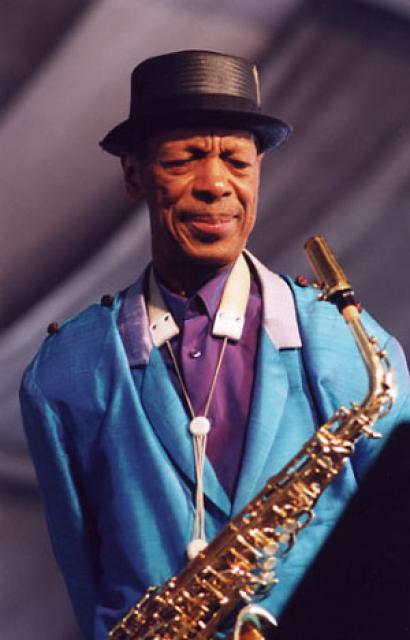
Ornette Coleman
 USA
USA- Ornette Coleman: A Revolutionary Jazz Musician
- The Early Years and Musical Journey
- Struggles and Breakthrough
- A Prolific and Experimental Career
- The Legacy and Lasting Impact
Ornette Coleman: A Revolutionary Jazz Musician
Ornette Coleman, a jazz innovator, saxophonist, composer, and trumpeter, was known for his avant-garde and revolutionary music. He is a polarizing figure in the music world, with some considering him a genius who revolutionized the art form, while others view him as a charlatan and troublemaker who disrespected academic art. Very few individuals have been able to change the course of history, especially in the creative field. However, Coleman was not one to adhere to traditional norms.

The Early Years and Musical Journey
Born in the small town of Fort Worth, Texas, Ornette Coleman grew up in poverty and faced the challenges of racism. He did not receive a formal musical education, which ultimately shaped his revolutionary and innovative approach to music. Coleman had no reverence for harmony, tonality, or proper transposition. At the age of fourteen, he taught himself to play the saxophone and read sheet music. By fifteen, he formed his first band.
Struggles and Breakthrough
Before finding success in music, Coleman had to work various menial jobs, such as operating an elevator station. However, at nineteen, he decided to change his life. He moved to Los Angeles, where his musical ideas initially proved too daring to attract a substantial audience. Nevertheless, in Los Angeles, he found a few musicians who were fascinated by his approach.
After some time, Coleman, a young man in his early twenties, made his appearance at the Five Spot, a trendy New York club. It was the early 1950s. It took him eight years before he released his first album, "Something Else." It was evident that Ornette Coleman was the pioneer of a new era in jazz, known as the "free jazz era." While it was a musical revolution then, his style of playing is now seen as a classic in jazz.
A Prolific and Experimental Career
Coleman continued to release albums one after another, totaling fifteen throughout his career. His work was often met with critical and even hostile reception. However, this did not deter him from experimenting with music and disregarding important components such as verse structure, tonality, and rhythmic symmetry.
In 1963-64, Coleman decided to learn new instruments. Despite being in demand as a musician with a busy schedule of concerts and recordings, he abandoned performances to learn how to play the trumpet and violin. He also stopped using the piano in his performances, a rule he adhered to until the 1990s.
Spending several years traveling in Africa, Ornette Coleman incorporated unique ethnic elements and rhythmic solutions into his music, starting in 1973 when he formed the band Prime Time.
The Legacy and Lasting Impact
Ornette Coleman's music remains divisive, with some considering him a genius who revolutionized the art form, while others view him as a charlatan. However, Coleman himself seems uninterested in these clashes. He leads a somewhat reclusive life and does not have any close friends or followers in the jazz world. He continues to release albums and participate in festivals. In 2009, he became the director of the Meltdown Festival in London, an honor previously held by musicians such as David Bowie, Patti Smith, John Peel, and Lee "Scratch" Perry.
Ornette Coleman passed away on June 11, 2015, in New York City from cardiac arrest. His legacy as a revolutionary musician and his impact on the jazz genre will always be remembered.