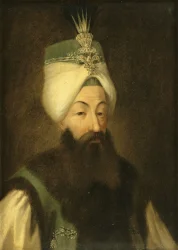
Osman I
Osman I gave his name to the Ottoman dynasty, but the empire later associated with him began as a modest frontier principality in northwestern Anatolia. He ruled in a region where the weakening Byzantine Empire, Turkic principalities, and the remnants of Seljuk power met. From that contested borderland, Osman built a following whose successors would expand across three continents. His historical importance is immense, even though the details of his life remain difficult to separate from legend.
A leader on the Byzantine frontier
Osman was born around 1258, probably in the region of Söğüt in northwestern Anatolia. He is traditionally described as the son of Ertuğrul, a Turkic frontier leader, though early Ottoman family history is not fully documented. The lands he governed lay near Byzantine-held towns and routes, giving him opportunities to raid, negotiate, and gather support from warriors and local allies.
The early Ottoman story is unusually hard to reconstruct. No contemporary Ottoman chronicle from Osman’s lifetime survives, and later dynastic histories were written more than a century after his death, when the family had become an imperial power. One of the most useful early accounts comes from the Byzantine historian George Pachymeres, who mentions Osman in connection with the Battle of Bapheus in 1302. The clash near Nicomedia was an important success against a Byzantine force and helped establish Osman as a formidable frontier leader.
His power likely grew through a mix of military campaigns, personal alliances, and the ability to attract followers from the shifting borderlands. Later histories often describe his movement as a religious war against Byzantium, but modern scholars caution that the early principality was more complex. It drew people with different motives, including the promise of land, influence, and opportunity as well as religious commitment.
From a principality to an empire
Osman’s rule is usually dated from the late thirteenth century until his death, around 1323 or 1324. The exact dates and sequence of his campaigns are uncertain. He is remembered as the founder because the dynasty that grew out of his household became known as the House of Osman, and the name “Ottoman” derives from his own.
A famous story says Osman dreamed of a tree whose branches spread over the world, a vision interpreted as a prophecy of his descendants’ future empire. The tale appears in much later Ottoman chronicles, not in records from Osman’s own time. It reveals how later generations explained the dynasty’s extraordinary rise, and how they framed its success as part of a sacred destiny.
Osman’s son Orhan succeeded him and expanded the principality’s reach. Within a few generations, the Ottomans crossed into Europe and captured major Byzantine cities. The vast empire that followed was not created by Osman alone, but his leadership gave the dynasty its starting point. He remains a compelling founder figure: part historical frontier ruler, part symbol shaped by the empire that bore his name.