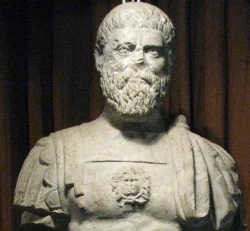
Otho
Marcus Salvius Otho rose from the Roman elite to the imperial throne during one of the most turbulent years in Rome’s history. His reign in 69 CE lasted barely three months, caught between the fall of Nero and the struggle among rival generals that became known as the Year of the Four Emperors. Otho seized power with the backing of the Praetorian Guard, then chose death over continuing a civil war after his forces were defeated.
An ambitious young aristocrat
Otho was born on 28 April 32 CE into a distinguished Roman family. His father held high office, and the family’s standing opened doors in imperial society. As a young man, Otho became known at the court of Nero, where he cultivated a reputation for extravagance and close association with the emperor.
His marriage to Poppaea Sabina brought him further into Nero’s orbit. Ancient accounts say that Nero became enamored of Poppaea and that Otho was sent away to govern Lusitania, in the western part of the empire. There, as governor, Otho acquired administrative and military experience. When Galba revolted against Nero in 68 CE, Otho joined him and helped secure support in Spain. Nero’s death and Galba’s accession appeared to give Otho a path back to the center of power.
From ally to emperor
Otho expected to benefit from his support for Galba, but the new emperor disappointed him. In January 69, Galba adopted Lucius Calpurnius Piso as his heir. Otho, passed over and burdened by debts, turned to the Praetorian Guard, whose members were dissatisfied with Galba’s leadership and rewards.
On 15 January, soldiers acclaimed Otho as emperor. Galba and Piso were killed in the upheaval, and the Senate recognized Otho. His rise was swift, but the empire was already dividing: the legions in Germania had declared for their commander, Aulus Vitellius, and were marching toward Italy.
A brief and embattled reign
Otho tried to consolidate support, presenting himself as a successor who could restore stability after Nero’s excesses. He also faced a challenge he had inherited from Galba: Vitellius had a powerful army and a rival claim. Otho gathered troops from the provinces and sent forces north to meet the advancing Vitellian army.
The armies clashed near Bedriacum, close to Cremona, in April 69. Otho’s side had some early success in the campaign, but the decisive engagement ended in defeat. His commanders and remaining supporters urged him to continue fighting, and reinforcements were still expected from the Danube provinces. Yet further resistance risked widening the conflict and bringing more Roman soldiers to their deaths.
A final decision
On 16 April 69, at Brixellum in northern Italy, Otho took his own life. He had ruled for about three months. Ancient writers portrayed his death as a deliberate effort to spare Rome another battle, though their accounts also reflect the political arguments and moral ideals of their time. Vitellius took the throne, only to be overthrown later that same year by Vespasian.
Otho’s place in history remains bound to the compressed violence of 69 CE. He had helped bring down Galba and claimed the empire for himself, but his final act halted his own supporters’ campaign. That combination of ruthless ambition and a reported willingness to end the struggle has made his short reign one of the most debated episodes of Rome’s imperial crisis.