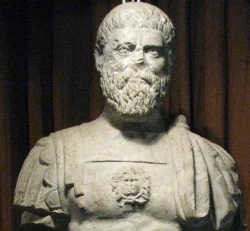
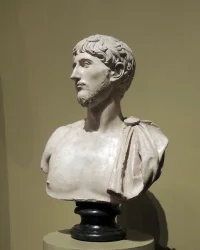
Pyrrhus
Pyrrhus of Epirus was one of the most audacious generals of the Hellenistic age. He challenged Rome in southern Italy, campaigned in Sicily, briefly ruled Macedonia, and repeatedly returned to the battlefield even after costly setbacks. His victories could be so expensive that his name became attached to the phrase “Pyrrhic victory,” a triumph that weakens the winner almost as much as defeat would.
A Prince in a Contested Kingdom
Pyrrhus was born around 319 BCE into the Molossian royal house of Epirus, a kingdom in northwestern Greece. As a child, he was caught up in succession struggles and spent part of his youth in exile. He regained the throne with help from the Macedonian king Demetrius I, but lost it again amid shifting alliances. In 297 BCE, with support from Ptolemy I of Egypt, Pyrrhus returned to power and established himself as king.
Like other Hellenistic rulers, Pyrrhus sought military glory and dynastic influence. He claimed descent from the heroic house of Aeacus, linking his lineage to Achilles. Ancient biographical accounts, especially Plutarch’s Life of Pyrrhus, preserve many vivid episodes, but they were written long after his death and must be read as literary as well as historical narratives.
War with Rome
In 280 BCE, the Greek city of Tarentum in southern Italy called on Pyrrhus for help against Rome. He crossed the Adriatic with an army that included war elephants, animals unfamiliar to the Romans. Pyrrhus defeated Roman forces at Heraclea and again at Asculum, but both victories came at heavy cost. Plutarch later attributed to him the observation that another such victory would ruin him; whether he said those exact words is uncertain, but the sentiment captures the strain of the campaign.
Pyrrhus tried to turn battlefield success into a settlement with Rome, but negotiations failed. He then crossed to Sicily, where Greek cities sought his help against Carthaginian power. He won initial successes and became a leading figure on the island, but his rule alienated local allies and the campaign became difficult to sustain. By 275 BCE he had returned to Italy, where the Romans eventually checked his advance at Beneventum.
A Restless Campaigner
After leaving Italy, Pyrrhus continued to pursue power in Greece. He briefly ruled Macedonia and later attempted to capture Sparta. In 272 BCE, he entered Argos amid a local conflict. Fighting erupted in the city at night, and Pyrrhus was killed in the confusion. Plutarch’s account tells that a woman dropped a roof tile from above, stunning him and allowing an enemy soldier to strike him down. The dramatic story became famous, though its details cannot be independently confirmed.
Pyrrhus’s campaigns showed exceptional tactical skill, but he struggled to convert victories into stable control. Armies, alliances, and cities repeatedly slipped from his grasp, while long wars drained his resources. He died at about forty-six, having spent much of his life fighting to gain or recover a throne.
Legacy
Pyrrhus left a lasting imprint on Roman memory and military vocabulary. His struggle delayed Roman expansion in southern Italy, even though Rome ultimately prevailed. The adjective “Pyrrhic” now describes a success achieved at such cost that it scarcely feels like a success at all—a fitting shorthand for the brilliant but precarious career of Epirus’s most famous king.