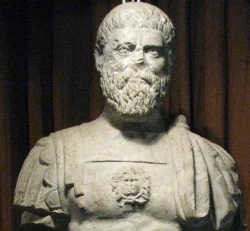
Pertinax
Pertinax rose from modest beginnings to the highest office in Rome, only to be killed by the very soldiers who had helped make him emperor. His reign lasted just 87 days in 193, the opening crisis of the Year of the Five Emperors. Remembered as a disciplined administrator after the excesses of Commodus, he tried to restore order quickly—and discovered how dangerous reform could be when the imperial guard expected reward and privilege.
From Teacher to Commander
Publius Helvius Pertinax was born in Liguria in 126 CE. His father was a freedman, and ancient accounts say that Pertinax began his working life as a teacher. He later entered the army, where ability and ambition carried him through a series of commands in Syria, Britain and along the Danube and Rhine frontiers.
Pertinax built a distinguished public career under Emperor Marcus Aurelius, serving as a commander, consul and provincial governor. He governed several provinces, including Syria and Britain, and later became proconsul of Africa. Under Commodus, he served as prefect of Rome, one of the highest administrative offices in the empire.
Accession after Commodus
Commodus was assassinated on December 31, 192. The conspirators who had arranged his death turned to Pertinax, then prefect of Rome, as a respected senior official who could stabilize the state. The Senate recognized him as emperor on January 1, 193.
Pertinax inherited an imperial treasury strained by Commodus’s spending and a Praetorian Guard accustomed to generous payments. He sought to reduce expenses, restore discipline and present himself as a servant of the state rather than a ruler above it. He sold off some of the imperial property and took steps to reward soldiers and veterans, but he could not satisfy every demand or quickly repair the government’s finances.
The Guard’s expectations soon became a crisis. Pertinax tried to reassert imperial authority over the Praetorians, while the soldiers feared losing the privileges they had enjoyed under Commodus. His effort to restrain them left him with enemies inside the very force responsible for his personal safety.
Assassination and Aftermath
On March 28, a group of Praetorian Guards entered the palace and killed Pertinax. His brief rule had lasted less than three months. The soldiers then backed Didius Julianus, who secured the throne by promising them a substantial payment. The episode became notorious as an example of the growing power the Praetorian Guard could wield over Rome’s emperors.
Pertinax’s death triggered a wider struggle. Provincial armies declared their own commanders emperor, and Rome entered the civil conflict now called the Year of the Five Emperors. Septimius Severus eventually prevailed and later honored Pertinax’s memory, presenting his own rule as a return to the older emperor’s standards.
Legacy
Pertinax’s short reign left little time for lasting reform, but it exposed the instability of imperial succession and the cost of challenging the Praetorian Guard. His rise from a freedman’s family to the throne made him an unusual emperor; his rapid fall showed that personal reputation and administrative skill could not overcome the armed politics of Rome in 193.