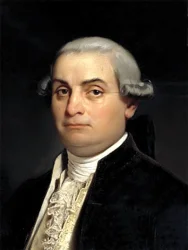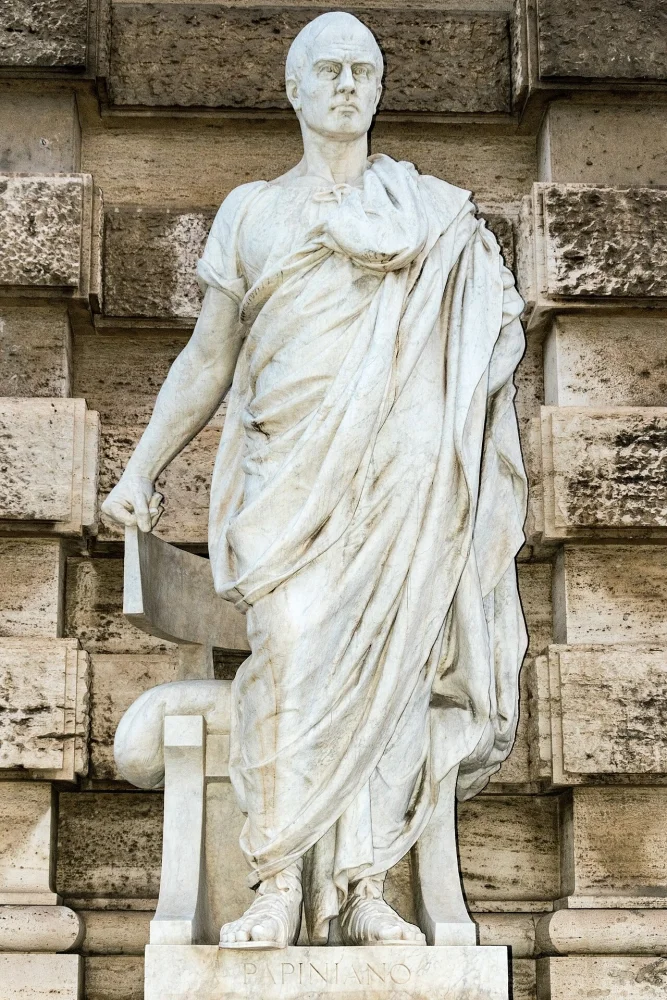
Papinian
Papinian was one of the most admired legal thinkers of ancient Rome. A senior adviser to the Severan emperors, he helped administer the empire while producing legal writings that later generations treated as authoritative. His death after the murder of Emperor Geta became part of his legend: later accounts presented him as a jurist who refused to provide a defense for a ruler’s crime.
A Jurist in Imperial Service
Aemilius Papinianus, known simply as Papinian, was born around 142 CE. The details of his early life are uncertain, and the surviving evidence about his career is fragmentary. He rose to prominence under Emperor Septimius Severus, serving in the imperial administration and eventually as master of petitions, an important office that handled requests and legal matters directed to the emperor.
Around 203, he became praetorian prefect, one of the highest offices in the Roman state. The prefects commanded the Praetorian Guard and also served as senior advisers and administrators. The role placed Papinian close to the center of imperial power, where legal judgment and political responsibility often met.
Legal Writings and Influence
Papinian wrote extensively on Roman law, addressing questions of private law, procedure, and public administration. His works included the Quaestiones and Responsa, collections of legal discussions and opinions. Much of his original writing has been lost, but excerpts survived in later compilations, especially the Digest of Emperor Justinian, assembled in the sixth century.
His reputation endured because of the precision and care attributed to his legal reasoning. In 426, an imperial law known as the Law of Citations named Papinian among five jurists whose writings could be relied upon in court. When authorities disagreed, the law generally instructed judges to follow the majority view and gave Papinian’s opinion special weight in the event of a tie. This exceptional standing reflected the high esteem in which later Roman law regarded him.
The Severan Succession and His Death
After Septimius Severus died in 211, his sons Caracalla and Geta became co-emperors. Their rivalry soon became violent. In 212, Caracalla arranged the murder of Geta and moved against people associated with his brother.
Papinian was killed during the subsequent purge. Later historians connected his death to a refusal to justify Geta’s murder, but the details are not fully secure. One famous account has Caracalla asking him to defend the killing and Papinian replying that it was easier to commit fratricide than to excuse it. This line helped turn the jurist into a symbol of legal conscience, though it comes through later tradition rather than a contemporary record.
Legacy
Papinian’s influence outlasted the empire in which he served. His opinions remained part of the legal material studied and cited by Roman lawyers, and the Digest preserved his name for future generations. His reputation combined two ideals: technical mastery of law and the courage to resist political pressure. Even when the story of his final stand is treated cautiously, it explains why Roman legal tradition remembered him not only as an eminent jurist, but also as a figure whose authority could challenge that of emperors.