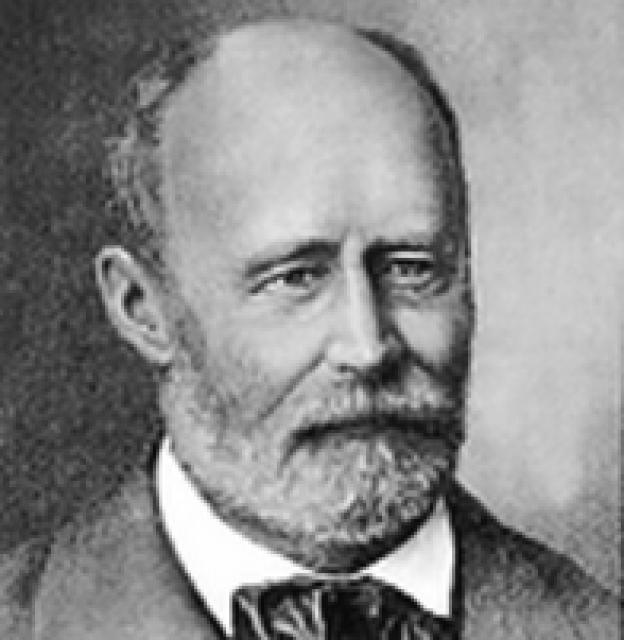
Paul Anton de Lagarde
 Germany
- Paul Anton de Lagarde: A German Orientalist
- Contributions to Oriental Studies
- Semitic Linguistics
- Biblical Criticism
- Political and Religious Views
- Influence
Paul Anton de Lagarde: A German Orientalist
Early Life and Academic CareerPaul Anton de Lagarde (1827-1891) was a German Orientalist and professor at the University of Göttingen. His early works, such as "Gesammelte Abhandlungen" (1866), primarily focused on the Iranian world.
Contributions to Oriental Studies
Lagarde made significant contributions to Iranian languages in works like "Beitr?ge zur baktrischen Lexikographie" (1868), "Armenische Studien" (1877), and "Persische Studien" (1884). He also published ancient texts in Syriac and related Greek texts.
Semitic Linguistics
Lagarde's research extended to Semitic languages as well. His works "Semitica" (1878-1879), "Orientalia" (1879-1880), and "Aegyptiaca" (1883) examined Semitic languages comparatively. His "Uebersicht ?ber die im Aram?ischen, Arabischen und Hebr?ischen ?bliche Bildung der Nomina" (1889) was particularly important for Semitic linguistics.
Biblical Criticism
Lagarde also dedicated several publications to biblical criticism. In "Kanonische B?cher des Alten Testaments und griech. Sprache" (1883), he attempted to reconstruct the Septuagint translation in its three different versions. Other theological and philological works include "Symmicta" (1877-1880) and "Mitteilungen" (1884-1891).
Political and Religious Views
Lagarde's writings extended beyond Oriental studies into political and religious spheres. He wrote on topics such as the relationship between the German state and religion in "Ueber das Verh?ltniss des deutschen Staates zu Theologie, Kirche und Religion" (1873). He also published political essays and writings on the state of the German Empire.
Influence
Lagarde's collected publicistic works were published as "Deutsche Schriften" in 1891. He became a foreign member-correspondent of the St. Petersburg Academy of Sciences in 1890. His anti-Semitic views, alongside those of Houston Stewart Chamberlain, served as an ideological basis for the synthesis of anti-Semitic beliefs in Germany.