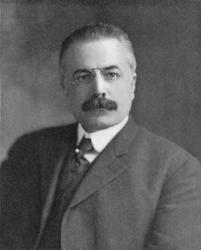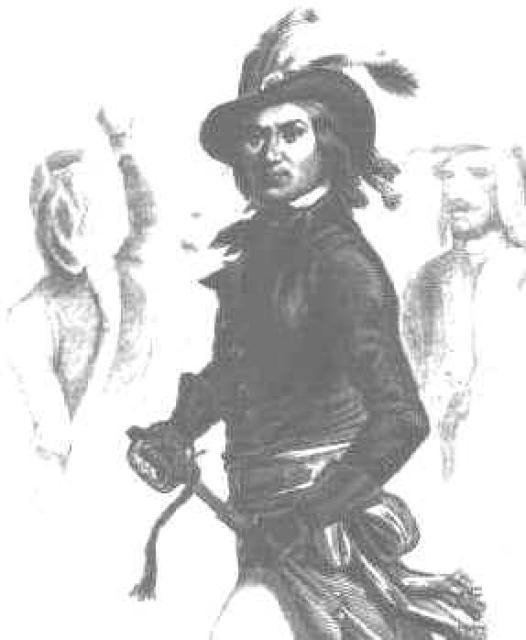
Paul Barras
 France
- Biography of Paul Barras
- Early Life
- Political Career
- Consolidating Power
- Rise to Power
- The Directory
- Later Years
Biography of Paul Barras
Paul François Jean Nicolas, Viscount of Barras, was a French political figure closely associated with the end of the French Revolution, just as Mirabeau was associated with its beginning. Barras represents Thermidor, the Directory, and the power of the nouveaux riches, the "new rich" that every revolution inevitably produces. Those who, more than others, are interested in the stability of the political order due to their own material interests are able to "tame" the revolution. Those who can extinguish its flames follow them. Napoleon Bonaparte followed in the footsteps of Barras.
Early Life
Paul François Jean Nicolas, Viscount of Barras, came from a family "as ancient as the rocks of Provence." He was born in Fox-Amphoux in the south of France. After completing his education, at the age of 16, he began a typical military career for a noble offspring. However, at the age of 28, after several campaigns, he retired as a captain. Barras settled in Paris and successfully squandered his fortune. In 1789, the revolution caught up with him. Like many young men of his circle, Barras was not unfamiliar with the new ideas of his century. He could discuss the rights of the nation and the vices of despotism, although politics seemed to interest him much less than secular and not entirely secular entertainments. The beginning of the Estates General and their subsequent transformation into the National Assembly suddenly aroused his curiosity. When the crowds of Parisians stormed the Bastille, Barras wanted to see this extraordinary sight for himself. However, curiosity alone was not a reason to dive headfirst into the revolutionary whirlpool like others. Without making any attempt to get involved in the rapidly developing events in Paris, Barras left the capital and returned to his homeland. At first glance, this step was surprising because almost all ambitious people flocked to Paris with the start of the revolution, which, however, had always offered exceptional opportunities for those dreaming of a career. But that was the plan: a beginning politician could not break through in the capital without the support of the provinces. Barras understood that he needed to secure such support.
Political Career
Back home, Barras became heavily involved in politics and soon obtained the position of administrator of the Var department. His personal affairs also turned out well: the revolution abolished noble titles, and the former Viscount married a woman of humble origin, but with a very substantial dowry. In addition, the marriage was non-demanding, as his wife remained in Fox-Amphoux and never sought to follow her husband. Several weeks after the wedding, in the autumn of 1792, Barras was elected to the National Convention on an additional list. Initially, the newcomer remained inconspicuous among the deputies. He rarely took the podium of the Convention, tried not to take too active positions, and generally spoke as little as possible. However, he established a close connection with the Jacobin Club, and when the fate of "Citizen Capet" (King Louis XVI) was decided, he decisively voted for the execution of the king. Finally, Barras was noticed and entrusted with important duties: in the spring of 1793, the Convention sent him and another deputy, Fréron, on a mission to the Upper and Lower Alps, where they were supposed to expedite the recruitment of soldiers for the Republican army. The mission essentially meant having almost unlimited power over several departments.
Consolidating Power
While on the road, Barras and Fréron heard news of the defeat of the Girondists and the beginning of the uprising in the south of France, where the administrations of several departments stood against the expulsion of the Girondist faction from the Convention. Marseille and Toulon were engulfed in rebellion. As an observer appointed by the Convention to the Italian army, Barras took part in the siege of Toulon, where he first met Napoleon Bonaparte (for more information, see the "19th Century" volume). The meeting was brief, but Barras likely remembered the young general. As for his own participation in combat operations, according to one version, it was significant, and according to another, rather modest. His extraordinary revolutionary zeal manifested itself later, when the uprising was suppressed. Barras and Fréron eagerly set about restoring order in the southern departments, organizing mass executions of rebels and sympathizers. At the same time, as rumors had it, they did not forget to actively improve their financial situation. To punish the rebellious cities, the friends came up with the idea to strip them of their historical names: Toulon became known as Port-la-Montagne, and Marseille became the Nameless City. The enraged Marseillais, as it was their city that gave the name to the most famous song of the revolution - "La Marseillaise" - soon reported Barras' profiteering to the Convention. Maximilien Robespierre, nicknamed "The Incorruptible," and especially his younger brother Augustin immediately turned against him. In January 1794, Barras was recalled to Paris. The sideways glances of the Convention members and the isolation he found himself in did not bode well. Barras anxiously awaited the inevitable end of his career, which, during those times, usually ended with the guillotine. It seemed that the wheel of terror was about to catch up with him...
Rise to Power
Did the opponents of the Committee of Public Safety prepare a counterstrike? Was there a conspiracy, or did the "force of circumstances" crush the Jacobin dictatorship? Of course, Barras sought like-minded individuals. He became close friends with Talleyrand and Fouché. His house became a gathering place for Lecointre, Fréron, and Rover... The coup of 9 Thermidor (27 July 1794 - Thermidor means "hot" month) saved their lives and dramatically changed the course of the revolution, putting an end to the Jacobin dictatorship. Thermidor launched Barras to the forefront of high politics. Contrary to the prevailing legend, he did not actively participate in the events that unfolded in the Convention on the eve and day of the coup. But his past military experience played in his favor: on the evening of 9 Thermidor, Barras was appointed the commander-in-chief of the National Guard of Paris. During the night, he gathered the forces of the Parisian sections loyal to the Convention and stormed the city hall, where the leaders of the Jacobin dictatorship - Robespierre, Couthon, Saint-Just, and Lebas - were hiding. This could not but affect his popularity both in the Convention and on the streets of the capital. Gradually, Barras became more influential, although initially his role was insignificant. Old accusations of theft and abuse of power resurfaced for a while, but in early 1795, Barras was completely exonerated. He was given the rank of brigadier general and elected to the Committee of Public Safety (which emerged in place of the Jacobin Committee of Public Safety). Thanks to this appointment, Barras was once again in the spotlight in the autumn. In October 1795 (during the revolutionary calendar's month of grape harvesting - Vendémiaire), royalists staged an uprising in Paris. They managed to bring out 1,220 of their supporters onto the streets. As a member of the Committee of Defense and commander-in-chief of the internal forces, Barras turned to the young general, whom he remembered from Toulon - Napoleon Bonaparte - for help. The cannons drowned out the cries of the crowd, which was shot down near the Church of St. Roch. Barras became the savior of the Republic again, sharing the laurels with Bonaparte. From then on, Barras' role in the Convention became one of the leading ones.
The Directory
In August (the month of "golden fruits" - Fructidor), the Convention adopted a new constitution. Immediately after the "Vendémiaire Crisis," elections were held for the new organs of power: the Council of Five Hundred and the Council of Elders. They formed the new government - the Directory, which was in charge of the ministries. Barras was elected as one of the five directors. Although he ranked last on the list based on the number of votes cast for him, he was the only one who managed to hold onto his position until the end of the Directory's existence. Thermidor and the Directory were also part of the revolution, but it was very different from the Jacobin revolution. The somber ideals of the "republican virtue" corset that had tightened for a decade were replaced by money interests and the joys of life, though only for those who could afford it. There were quite a few such people: in the murky waters of revolutions, it is convenient to catch fish. Wealth no longer hid and put itself on display: balls and revelries never ceased. Salons flourished: Madame Récamier vied with Madame Tallien. The nouveaux riches and the surviving old nobility rushed to intermarry. In this colorful society, Barras, the "republican king," felt excellent. The Château de Grasse became the center of his "court." Luxury, pleasure, women, and politics coexisted perfectly in his life. However, politics required caution and a certain firmness.
Later Years
After the victory over the royalists in Vendémiaire, Barras decided to relinquish his military powers and focus solely on politics. Throughout his years in power, he never forgot to secure his rear and regularly renewed his deputy mandate in the provinces. He left the position of commander-in-chief of the internal forces and, along with it, his lover, Joséphine Beauharnais, whom he had grown tired of, to General Bonaparte.
Despite his noble origins and aristocratic aspirations, ex-Viscount Barras remained a staunch republican and never entertained the thought of a possible restoration of the monarchy in France. After dealing with the royalists, he turned his attention to the émigrés and non-juring priests, the main stronghold of counterrevolution. Thus, a blow was delivered to the right. On the left, the Jacobins posed a threat to stability. Now, the word itself had acquired a negative connotation, primarily referring to the organizers of the Terror. In the recent past, Barras himself was a Jacobin and a "terrorist," so he acted with caution. With an iron fist, he included all his old personal enemies in the proscription lists (which declared people outlaws), but managed to preserve a significant portion of the former Jacobin administration. The most odious figures, such as the executioner from the Vendée, Carrier, were executed. The majority of those convicted were deported to Cayenne (in French Guiana).
In general, behind-the-scenes games were his forte, and there was no shortage of opponents. In the autumn of 1797, with the support of Bonaparte, Barras dealt with the royalists. But he already understood that it was not the right wing that posed the main threat to his power, but rather a powerful, romantically glorified young general. After the successful campaign of the French army in Italy, when the capital was literally flooded with trophies, Barras felt that the popularity and ambition of Bonaparte made his own position too precarious. In order to send a potential rival far away from Paris, Barras insisted on the Egyptian campaign. In the spring of 1798, Bonaparte led French soldiers to the land of the Sphinx and pyramids. However, Barras' calculations did not prove successful. The sudden return of Bonaparte from Egypt caused a sigh of relief among the French, who were tired of the decade-long revolution: here was someone who could finally restore order. It was already impossible to resist Bonaparte.
The coup of 18 Brumaire (9 November 1799 - Brumaire means "foggy" month) marked the end of the French Revolution and put an end to Barras' career. For a while, he hoped that the first consul, the master of the new order, would remember Barras, but his expectations were in vain, and he soon voluntarily resigned.
It was now Bonaparte's turn to fear a rival who had lost the power game but could initiate a new one. Barras was first sent from Paris to his Château de Grasse, then to Belgium, from there to Provence, and in 1810, he was permanently banned from living in France. Forced to settle in Rome, he remained there until Napoleon's first abdication. Upon his return to his homeland, Barras once again surprised contemporaries with the luxury and lifestyle of his domestic "court," but he distanced himself from politics.
Few of Barras' associates had the opportunity to rest peacefully in their own beds. He, on the other hand, ended his life in his palace in Chaillot, where he wrote memoirs about what had so profoundly shaken France in the last decade of the 18th century.