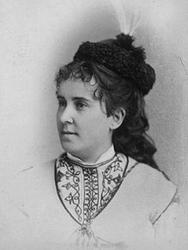
Pauline Donalda
 Canada
Biography of Pauline Donalda
Pauline Donalda, a Canadian opera singer and soprano, was born in 1882 in Montreal, Canada. Her parents were Jews from Russia and Poland, who changed their surname from "Lichtenstein" to "Lightstone". From a young age, Pauline possessed a beautiful voice and later studied on a scholarship at Royal Victoria College.
In 1902, she decided to travel to Europe to pursue her singing career. Before allowing her to go, her father insisted on an audition with new specialists in New York to ensure her talent. Walter Damrosch refused to listen to her, but French tenor Thomas Salignac spoke highly of her soprano voice.
That same year, she went to Paris on a grant from Donald Smith, Lord Strathcona, and studied vocal technique with Edmond Duvernoy, acting with Paul Lhérie, speech with Pierre Berton, and Italian language with Babette Rosen. In honor of her benefactor, she adopted the pseudonym "Donalda".
With the help of Massenet, Pauline made her debut on December 30, 1904, in Nice, singing the role of Manon. She later excelled in the roles of Marguerite, Micaëla, and Mimì. Under the direction of Leoncavallo himself, she soon performed as Nedda in "Pagliacci". Her London debut took place on May 24, 1905, at Covent Garden, where she performed the role of Micaëla. In late June of the same year, she sang in the premiere of Franco Leoni's "L'Oracolo". Pauline soon began to rival Nellie Melba, often replacing her and thus singing alongside Enrico Caruso. Her performances as Juliette and Zerlina were highly successful.
In the same Covent Garden, Pauline sang Marguerite in "Faust" in 1905, and one of her partners was French baritone Paul Seveilhac, whom she married in May of the following year. In the fall of 1905, she performed as Marguerite and Mimì at the Théâtre de la Monnaie in Brussels and then took a six-month vacation in the south of France on the advice of her doctor. She returned to Brussels in March to sing Manon and later performed Elsa in "Lohengrin" and Eva in "Die Meistersinger", showcasing her skill in Wagnerian roles.
On November 16, 1906, the singer made her debut in Canada, performing alongside her husband. On December 7 of the same year, she made her New York debut, and soon her American repertoire included operas such as "Faust", "Carmen", "Don Giovanni", "La Traviata", "Lohengrin", and "Pagliacci". However, this season proved to be incredibly challenging for Pauline, and she was ultimately disappointed with the Metropolitan Opera. The Teatro Colón in Buenos Aires also failed to meet her expectations, leading her to leave the United States.
Concentrating on the European opera scene, Pauline continued to tour actively. During the First World War, she spent it in Canada, giving numerous concerts, including charity events and performances for the army. In 1917, she returned to Paris to perform. By that time, her first marriage had ended in divorce, and Pauline remarried Danish tenor Mischa Léon in June 1918 in Paris. They performed together in Nice later that year in "Le Talisman". In 1919, after the reopening of Covent Garden, she returned to this stage for her final season.
After retiring from the stage, Donalda began teaching and opened a studio in Paris in 1922. She returned to her hometown in Montreal in 1937, opening her studio in Canada. In 1942, Pauline Donalda became the founder and director of the Opera Guild, leading it until 1969, presenting 29 operas, including several Canadian premieres, over 28 seasons. Among her students were many talented performers, such as Clarice Carson, Mary Henderson, and Eileen Law.
In 1967, Donalda received the Order of Canada. She passed away on October 22, 1970. Her beautiful, pure soprano voice with its delicate diction can be heard in recordings, including the compilation "Great Voices of Canada/Les Grandes voix du Canada".