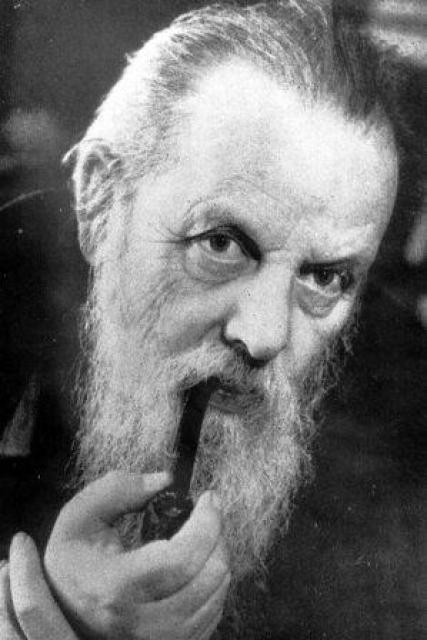
Pavel Bajov
- Early Life and Education
- Literary Pursuits
- "The Malachite Box" and Beyond
- Wartime Endeavors
- Recognition and Legacy
Early Life and Education
Pavel Petrovich Bazhov was born on January 15 (New Style: January 27), 1879, in the Sysertsky Factory, near Yekaterinburg, into the family of a mining foreman. He attended the spiritual school in Yekaterinburg from 1889 to 1893 and subsequently the Perm Spiritual Seminary from 1893 to 1899.
During his seminary years, Bazhov became involved in protests against reactionary teachers. Consequently, he received an attestation with a note of "political unreliability." This hindered his aspiration to enroll at the University of Tomsk.
Literary Pursuits
Bazhov worked as a teacher of Russian language and literature in Yekaterinburg and later in Kamyslov. During these years, he developed a passion for Ural folk tales. With the outbreak of the revolution, he focused on community work, connecting with railroad workers who supported Bolshevik positions.
In 1918, Bazhov joined the Red Army as a volunteer and participated in combat operations on the Ural Front. In 1923, he settled in Sverdlovsk and worked for the "Krestyanskaya Gazeta," where he published essays on the old factory life and the Civil War. During this period, he wrote over forty tales inspired by Ural factory folklore.
"The Malachite Box" and Beyond
Bazhov's most celebrated work, "The Malachite Box," a collection of tales, was published in 1939, earning him the State Prize. He subsequently added new tales to this compilation, such as "The Key-Stone" (1942) and "Tales of Germans" (1943).
Bazhov's tales, rooted in Ural folklore, masterfully blend realistic and fantastical elements. They are infused with motifs, language, and wisdom from folk traditions, capturing the philosophical and ethical ideas of the time.
Wartime Endeavors
During the Great Patriotic War, Bazhov dedicated himself to supporting Ural writers and those evacuated from other parts of the Soviet Union. Despite his deteriorating eyesight after the war, he tirelessly continued his editorial work and the collection and creative use of folklore.
Recognition and Legacy
In 1946, Bazhov was elected as a deputy to the Supreme Soviet. He actively responded to the concerns of his constituents. Bazhov received the Order of Lenin and was honored with the title of Hero of Socialist Labor in 1943.
Pavel Bazhov passed away in Moscow in December 1950 and was interred in Sverdlovsk. His works have been immortalized through adaptations in film, ballet, opera, music, sculpture, and painting. His legacy as a master of Ural storytelling continues to inspire generations.