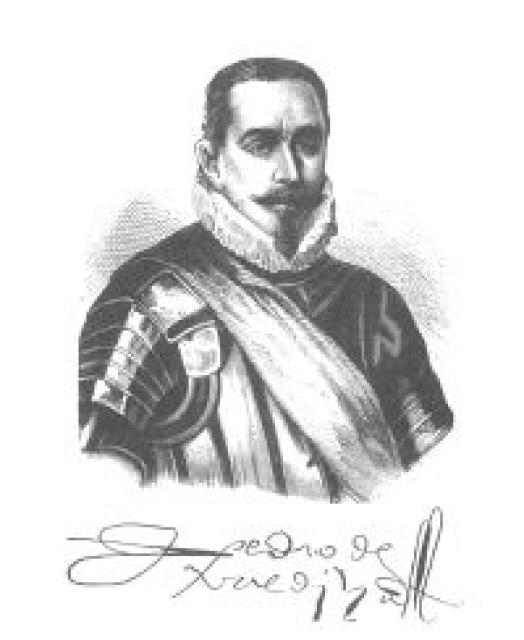
Pedro Valdivia
 Spain
- From Extremadura to the Americas
- Founding Santiago and Extending Spanish Rule
- Private Life and Political Scrutiny
- Tucapel and a Contested Legacy
Pedro de Valdivia came to Chile with ambitions that reached far beyond a single military campaign. A veteran of Spain’s wars in Europe and the conquest of Peru, he became the first governor of colonial Chile and founded Santiago, the capital that grew into one of South America’s major cities. His expansion of Spanish rule also brought war, dispossession and forced labor to Indigenous communities, and Mapuche resistance ultimately ended his life.
From Extremadura to the Americas
Born around 1497 in Spain’s Extremadura region, Valdivia entered military service as a young man and fought in the Italian Wars. He crossed the Atlantic in the 1530s and joined Spanish campaigns in Venezuela and the Caribbean before serving Francisco Pizarro in Peru. There he gained experience, rank and access to the resources he would need for a new expedition.
In 1539, Pizarro authorized him to lead a campaign into Chile, then known to Spaniards as New Extremadura. Valdivia gathered a small Spanish force and Indigenous auxiliaries and set out from Cuzco in 1540. The journey south across desert and mountain terrain was difficult, but the expedition reached the central valley and established a foothold near the Mapocho River.
Founding Santiago and Extending Spanish Rule
In February 1541, Valdivia founded Santiago del Nuevo Extremo. The settlement became a base for the Spanish occupation, though it was soon attacked and badly damaged in an Indigenous uprising. Valdivia and the settlers rebuilt it and pushed their authority outward, establishing La Serena in 1544 and advancing south to found or establish other settlements, including Concepción, La Imperial and Valdivia.
The expansion depended on military campaigns and the encomienda system, which assigned Spanish settlers claims over Indigenous tribute and labor. Communities resisted the seizure of their land and autonomy. Valdivia’s letters to the Spanish crown presented colonization as a royal and Christian enterprise, while his administration allocated land and Indigenous labor to reward followers and sustain the colony.
In 1547, he returned to Peru during the rebellion led by Gonzalo Pizarro and fought for the royalist forces of Pedro de la Gasca. Afterward, La Gasca confirmed his governorship. Valdivia returned to Chile in 1549 and continued pushing Spanish settlements farther south, into territory where resistance was growing.
Private Life and Political Scrutiny
Valdivia had married Marina Ortiz de Gaete in Spain in 1527, but she remained in Europe for years. In the Americas, he formed a long relationship with Inés de Suárez, who accompanied his expedition to Chile and became a prominent figure in the early settlement. When Valdivia faced a judicial inquiry in Peru, La Gasca absolved him while requiring him to end that relationship and arrange for his wife to join him in Chile.
His correspondence reveals a leader who carefully promoted his achievements and sought resources, titles and royal recognition. That self-presentation formed part of the political work of conquest: his letters documented settlements and battles while making the case for continued support from the crown.
Tucapel and a Contested Legacy
In December 1553, Mapuche forces led by the young military leader Lautaro defeated Valdivia’s force at the Battle of Tucapel and captured him. The details of his death differ among historical accounts, but he was killed after the battle. His defeat showed that Spanish control south of the Biobío River remained fiercely contested.
Valdivia’s name endures in the city of Valdivia and in Chile’s national history as a founder of Spanish settlements. That legacy is inseparable from the violence of conquest and from the Mapuche communities who fought to defend their territory. He was at once an ambitious colonial organizer and a military leader whose expansion met determined Indigenous opposition.


