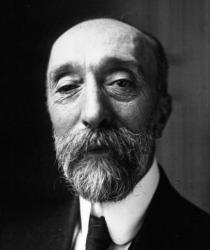
Perry Anderson
 Great Britain
Biography of Perry Anderson
Perry Anderson is a British-American historian, sociologist, and political scientist, known as one of the leading Marxist intellectuals of our time and one of the main theorists of the "New Left" movement. He is the brother of historian Benedict Anderson. Anderson spent part of his childhood in China, where his father worked in customs. During World War II, the family moved to the United States, and later relocated to southern Ireland. He is a graduate of Worcester College, Oxford University, where he pursued a wide range of interests from philosophy to the study of Russian and French languages. Currently, he is a professor of history and sociology at the University of California, Los Angeles. He has served as the editor of the influential Marxist publication "New Left Review" from 1962 to 1982 and again from 2000 to 2003, and remains a member of its editorial board. Perry Anderson has authored numerous historical works in which he analyzes the development of human civilization from the perspective of historical materialism. In his works, including "In the Tracks of Historical Materialism" (1983) and "The Origins of Postmodernity" (1998), he further develops the Marxist approach to history. Two of Anderson's earlier works, "Passages from Antiquity to Feudalism" (1974) and "Lineages of the Absolutist State" (1974), gained widespread recognition for their breadth and universality in analyzing European history and social development.
Contributions to Western Marxism
In 1974, when Anderson was asked to write an introduction to a collection of articles dedicated to Western Marxist theorists, he discovered that there was no systematic exposition of the history of Marxist thought and its formal structures in the West after the October Revolution in Russia. The result was his "Considerations on Western Marxism," published in 1977 in the book "Western Marxism: A Critical Overview," which also included an essay on Antonio Gramsci's theory of hegemony ("The Antinomies of Antonio Gramsci"). While Anderson has faced unjustified criticism in his home country for favoring thinkers from continental Europe over those from Britain, in "Considerations on Western Marxism" he does not shy away from critical analysis of Western European Marxism in the "continental" tradition. Perry Anderson actively participated in the discussion of major innovations in Marxist theory in the second half of the 20th century, writing a series of polemical articles on Edward Thompson's work "The Poverty of Theory," the use of history and theory in left-wing politics. He also expressed support for humanistic Marxism, criticizing Louis Althusser's scientistic interpretation of Marx's legacy in the late 1970s. In the mid-1960s, the annual publication "Socialist Register" featured an essay by his colleague E.P. Thompson, which rejected Anderson's views on the dominance of the aristocracy throughout British history and his solidarity with "continental" European Marxists in contrast to radical British traditions and empiricism. Anderson's response to Thompson can be found in two of his works: an article for the "New Left Review" in January-February 1966 titled "Socialism and Pseudo-Empiricism" and a much larger review called "Arguments within English Marxism" (1980). According to Anderson himself, his books "Considerations on Western Marxism," "In the Tracks of Historical Materialism," and "Arguments within English Marxism" can be considered an "unintentional trilogy."
Critique of Postmodernism
In "The Origins of Postmodernity" and "In the Tracks of Historical Materialism," Anderson challenges the notion of postmodernism as a leftist movement, refuting his contemporary postmodernists and referring to Paris, the center of French poststructuralism, as the "new stronghold of intellectual reaction."