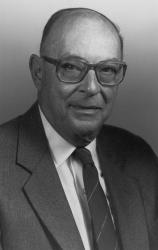
Persy Bridgman
 Great Britain
- Percy Williams Bridgman
- Pushing matter under pressure
- A philosopher of measurement
- Family and later years
Percy Williams Bridgman
Early life and educationPercy Williams Bridgman was born on April 21, 1882, in Cambridge, Massachusetts, to Raymond Landon Bridgman, a journalist and writer, and Mary Ann Maria Williams. He grew up in nearby Newton and entered Harvard College in 1900. A gifted student with a strong interest in mathematics and the physical sciences, he graduated summa cum laude in 1904, earned a master’s degree in 1905 and completed his doctorate in physics in 1908.
Bridgman remained at Harvard for nearly his entire professional life. He joined its physics department as a research fellow in 1908 and rose through the faculty, becoming professor in 1919, Hollis Professor of Mathematics and Natural Philosophy in 1926, and Higgins University Professor in 1950. He retired in 1954, having spent more than four decades teaching and conducting research there.
Pushing matter under pressure
Bridgman became one of the founders of modern high-pressure physics. Early in his research career, he set out to examine how materials behaved when compressed far beyond ordinary laboratory conditions. Existing equipment could not reliably create or contain the pressures he wanted, so he designed and built new apparatus himself. His ingenious seals and pressure vessels made it possible to conduct measurements under extreme pressure without the leaks and failures that had limited earlier work.
With these tools, he investigated how pressure changes the volume, viscosity, electrical and thermal properties, and phase transitions of solids and liquids. The experiments revealed that familiar substances could behave in unexpected ways when compressed. His methods steadily extended the range of pressures available for systematic study, opening a new experimental field with implications for materials science, chemistry, and geophysics. He described the techniques and findings in The Physics of High Pressure (1931), which became a standard work.
In 1946, Bridgman received the Nobel Prize in Physics “for the invention of an apparatus to produce extremely high pressures, and for the discoveries he made therewith in the field of high pressure physics.” The award recognized not just a single instrument but decades of painstaking experimentation that made otherwise inaccessible states of matter measurable. He also served as president of the American Physical Society in 1942 and received many other scientific honors.
A philosopher of measurement
Bridgman’s interests extended beyond laboratory physics. In The Logic of Modern Physics (1927), he argued that scientific concepts gain meaning through the operations used to measure or observe them. For example, a physicist should be clear about the concrete procedures behind a measurement rather than assume that a familiar word always refers to one self-evident property. This approach became known as operationalism and influenced later debates in philosophy of science and the social sciences.
Bridgman did not see himself as the founder of a rigid philosophical doctrine. His concern was practical: scientific language and methods should be examined carefully, especially when new theories challenge intuition. His work on high pressure and his writing about measurement shared that emphasis on precision, experiment, and intellectual honesty.
Family and later years
In 1912, Bridgman married Olive Ware, whose father, Edmund Asa Ware, had been the first president of Atlanta University. They had two children, Jane and Robert, and made their home in Cambridge. The family spent summers in Randolph, New Hampshire, where Bridgman enjoyed mountain climbing. He was also known for tending flower and vegetable gardens and for taking on carpentry and plumbing projects himself, a practical streak that echoed his hands-on approach in the laboratory.
Bridgman remained intellectually active after retiring from Harvard. He died in Randolph on August 20, 1961, at age 79, after a cancer diagnosis. He died by suicide, a fact later accounts have connected to his decision not to endure the disease’s final stages. His legacy lives on in the experimental methods he pioneered, in the continuing study of matter at extreme pressures, and in the enduring debate over how scientific ideas acquire meaning.