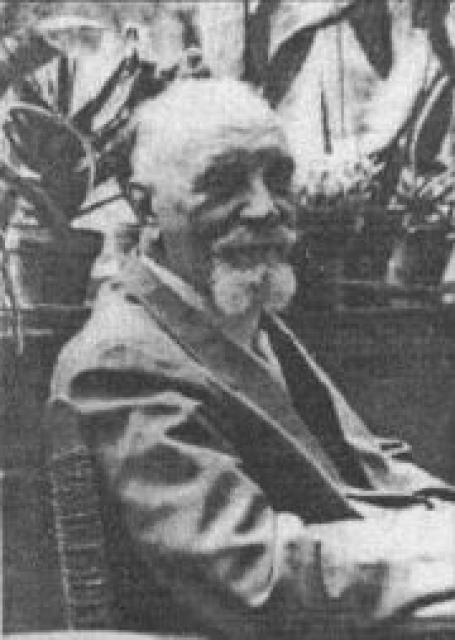
Petr Apraksin
 Russia
- Early Life and Military Service
- Involvement with the Red Cross and the Russo-Japanese War
- Political Career and Involvement with the Russian Assembly
- Later Career and Emigration
Early Life and Military Service
Count Sergei Alekseyevich Apraksin was born on an unknown date in Nervi, Italy, to the noble Apraksin family. He received his education at the First Moscow Cadet Corps and the Page Corps. In 1896, he became a second lieutenant in the 4th Life Guard Rifle Battalion. In 1897, he commanded His Majesty's company. In 1900, he was awarded the Order of Saint Stanislaus, 3rd class.
During the famine of 1898-99, Apraksin served as a Red Cross representative in the Volga regions. In 1901, he retired from military service as a reserve lieutenant and entered civil service in the Chancellery of the Council of Ministers. In the same year, he became a representative of the Siberian Railway Committee in the Amur Region.
Involvement with the Red Cross and the Russo-Japanese War
From 1900-02, Apraksin attended the Imperial Archaeological Institute of St. Petersburg. From 1902-03, he worked for the journal "Russkiy Vestnik," publishing numerous bibliographic articles.
During the Russo-Japanese War, Apraksin served on the Eastern Front as part of the medical unit of the Saint Eugenia community. He witnessed the siege of Port Arthur and the battles of Liaoyang and Mukden. From April to August 1904, he was attached to the Eastern Detachment under Count Keller. He later became a Red Cross representative for the 1st Siberian Corps.
For his services during the war, Apraksin received the Orders of Saint Anne, 3rd class; Saint Stanislaus, 2nd class with swords; and Saint Vladimir, 4th class with swords.
Political Career and Involvement with the Russian Assembly
On January 8, 1906, Apraksin gave a report to the Russian Assembly (RS) on "Impressions from the Theatre of Military Operations in Manchuria." He served in the Peasant Land Bank and the State Noble Land Bank until early 1907, when he became the vice-governor of Voronezh. From May 1911 to 1913, he served as the governor of Taurida.
From 1913 to 1917, Apraksin served Empress Alexandra Feodorovna as a chamberlain of the Imperial Court, overseeing the chancellery and court ceremonial. He was also a deputy chairman of the Special Committee of Grand Duchess Olga Nikolaevna and a member of the Tatiana Committee.
Apraksin was a member of the RS from 1902 and served on its council on several occasions. He was a proponent of monarchism and argued against hasty unification with other organizations.
Later Career and Emigration
Apraksin returned to the RS in 1914 and was elected vice-chairman. He served in this capacity until 1916, when he became the de facto leader of the organization.
During World War I, Apraksin was involved in the establishment of a Ladies' Committee for the Assistance of Sick and Wounded Soldiers, with his wife serving as its honorary chairwoman.
After the February Revolution, Apraksin left Tsarskoye Selo for the safety of his family. He remained loyal to the royal family and supported the construction of a memorial church in Brussels dedicated to Tsar Nicholas II.
During the Russian Civil War, Apraksin fled to Crimea, where he served as the last chairman of the Yalta administration. He escaped with the retreating forces of General Wrangel to Constantinople. He eventually settled in Belgium, where he died in Brussels.


