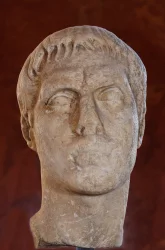
Pheidippides
Pheidippides is remembered around the world as the runner who carried news of victory from Marathon to Athens, but the earliest account tells a different story. The fifth-century BCE historian Herodotus describes an Athenian courier sent to Sparta before the Battle of Marathon to ask for military help. The famous post-battle run—and the runner’s death on arrival—emerged in later accounts, making Pheidippides a figure where history and legend meet.
The courier in Herodotus
Herodotus identifies Pheidippides as a trained long-distance courier, a profession sometimes called a day-runner. In 490 BCE, as a Persian force threatened Athens, the city’s commanders sent him to Sparta to request assistance. Herodotus says Pheidippides reached Sparta the day after leaving Athens, covering a formidable distance across difficult terrain.
In his account, Pheidippides also reported an encounter with the god Pan on Mount Parthenion. Pan asked why the Athenians did not honor him, and promised help. After the Persian invasion, the Athenians established a sanctuary and rites for Pan, linking the messenger’s report to the city’s religious life. Sparta, meanwhile, delayed sending troops until after a religious festival, so the Athenians fought at Marathon without the Spartan force.
The Marathon legend
Herodotus does not say that Pheidippides ran from Marathon to Athens after the battle. Later writers developed a separate story about a messenger racing to announce the Greek victory. Plutarch names the runner as either Eukles or Thersippus, while the second-century writer Lucian gives a name resembling Philippides and combines it with the Marathon-to-Athens journey and the messenger’s death.
Over centuries, these traditions merged in popular memory. The familiar tale in which Pheidippides reaches Athens, cries out that the Greeks have won, and collapses is compelling, but it is not the earliest or best-attested version. The historical Pheidippides is most securely associated with the pre-battle mission to Sparta.
From ancient story to modern race
The runner’s story gained new life in the nineteenth century. Robert Browning’s poem “Pheidippides,” published in 1879, blended the journey to Sparta with the later Marathon legend, presenting one heroic runner who both sought aid and announced victory. The first modern Olympic marathon, held in Athens in 1896, drew on this popular image and helped make the name Pheidippides synonymous with endurance running.
The modern marathon’s distance was set later, but the race kept its connection to ancient Greece. The actual road from Athens to Sparta described by Herodotus is much longer than the Marathon-to-Athens route, a distinction that has inspired its own modern endurance events.
Legacy
Almost nothing is known about Pheidippides beyond the ancient accounts of his mission. Yet the few details that survive tell of a skilled courier entrusted with a dangerous task at a critical moment. His name became a bridge between the Persian Wars and modern sport: part historical messenger, part literary hero, and an enduring symbol of the human capacity to run extraordinary distances.