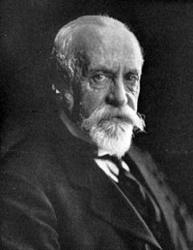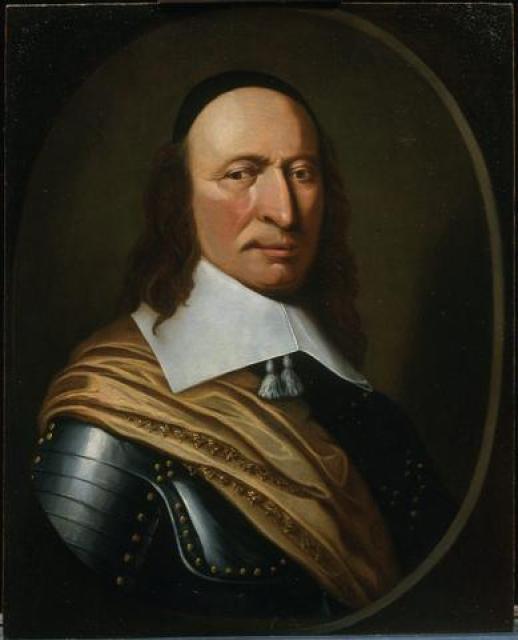
Pieter Stuyvesant
 Netherlands
Biography of Peter Stuyvesant
Peter Stuyvesant was the last governor-general of the Dutch colonies in North America, known as New Netherland, from 1647 to 1664. He was born to a Calvinist pastor in Friesland, and in 1632, he joined the Dutch West India Company. After 11 years of service, he was appointed as the governor of the islands of Curaçao and Aruba.
Conflict and Loss
During a clash with the Portuguese over St. Martin Island, Stuyvesant lost his right leg, which had to be replaced with a wooden one. In 1645, Stuyvesant was given control over all the company's possessions in the Caribbean Sea and north of it. The most promising of these was New Amsterdam, the predecessor of New York.
Challenges and Achievements
Upon his arrival in New Amsterdam in 1647, Stuyvesant found himself involved in a conflict with colonists who demanded self-governance modeled after Dutch cities. While he established a city council to appease them, he continued to have sole authority over all colonial affairs. He suppressed dissent, particularly religious dissent, and expelled Quakers from the colony, which caused protests from the residents of the Dutch town of Flushing.
Stuyvesant's accomplishments include expanding New Amsterdam beyond the southern part of Manhattan. He built a defensive wall that became known as Wall Street and a "broad canal" where Broadway now runs. In honor of his name, the Brooklyn neighborhood of Bedford-Stuyvesant and the Manhattan neighborhood of Stuyvesant Town were named.
Conflict with the English
In 1655, Stuyvesant, along with seven hundred colonists, sailed into the Delaware River, which he renamed New Amstel, and recaptured Fort Casimir from the Swedes. The governor of New Sweden ceded all rights to the colony to the Dutch. During Stuyvesant's absence, New Amsterdam was attacked by Native Americans, but upon his return, he managed to negotiate peace with them. However, his relations with the English deteriorated. In 1650, he conceded land to the English during the delineation of the New Netherland boundaries with Connecticut, which was deemed enough to establish several colonies.
In 1664, realizing the weakness of the Dutch positions in the region, the Duke of York sent four ships, led by Richard Nicolls, to America to take control of New Netherland from the Dutch. Unable to resist the English militarily, Stuyvesant surrendered New Netherland and retired to his farm, known as Bouwerij, on Manhattan Island, where he passed away in 1672. The bustling Bowery Street now stands in the location of his former farm. Stuyvesant was buried in St. Mark's Church, which was later visited by Dutch queens Juliana in 1952 and Beatrix in 1982.