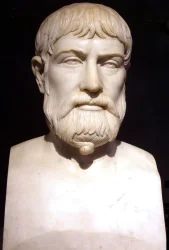
Pindar
Pindar’s poetry made the triumph of an athlete feel like part of a larger story about the gods, a city, and the limits of human fortune. Celebrated in antiquity as one of Greece’s greatest lyric poets, he wrote choral odes for winners at the major athletic festivals. Much of his work is now lost, but the surviving victory songs still reveal a writer of striking musical ambition and moral intensity.
A poet from Boeotia
Pindar was born around 518 BCE in or near Thebes, in the region of Boeotia. The ancient biographical accounts offer conflicting details, and little is known with certainty about his family or education. His career is better traced through the poems and the people who commissioned them. One of his earliest securely dated works, Pythian Ode 10, celebrated a young Thessalian athlete’s victory at Delphi in 498 BCE.
Pindar lived through a period of political tension and warfare, including the Persian invasions of Greece. Thebes, his home city, had cooperated with the Persians, a fact that later complicated how audiences viewed the poet. Yet his poetry praised Athens for its defense of Greece and celebrated patrons from many different cities. The commissions took him across the Greek world and made his art part of elite public life.
Songs for the games
Pindar’s best-known poems are victory odes, written to honor athletes who won at the Olympic, Pythian, Nemean, and Isthmian Games. These songs were designed for performance, often by a chorus, and celebrated not only an individual victory but the athlete’s family, community, and divine favor. Pindar could turn a sporting achievement into a meditation on inherited excellence, effort, luck, and the limits of mortal life.
His patrons included powerful rulers such as Hieron of Syracuse and Theron of Acragas. Olympian Ode 1, for example, commemorates Hieron’s victory in a horse race at Olympia. Rather than simply recounting results, Pindar drew on myth and local tradition to give each celebration a distinctive shape. His poems are famous for their sudden transitions, vivid images, and carefully balanced praise, qualities that later readers came to call “Pindaric.”
The surviving poetry and its afterlife
Pindar wrote in many forms, including hymns, processional songs, and dirges, but most of those works survive only in fragments or are lost. The complete poems passed down to later generations are his victory odes, preserved in four collections associated with the four major games. Ancient editors arranged them centuries after his death, allowing a portion of his work to reach readers through manuscript tradition.
The exact date of Pindar’s death is uncertain. His last securely datable ode points to the mid-fifth century BCE, and later sources provide differing accounts of his final years. What is clear is that his reputation endured: Greek and Roman writers treated him as a master of lyric poetry, and later poets studied the structure and force of his songs.
Pindar’s surviving odes preserve the sound and ceremony of a world where athletic contests were religious festivals and civic occasions. Their praise is shaped by the demands of patrons, yet the poems reach beyond celebration to ask what human achievement means under the gaze of the gods. That mixture of public honor, mythic storytelling, and reflection is why his work remained a model for centuries.