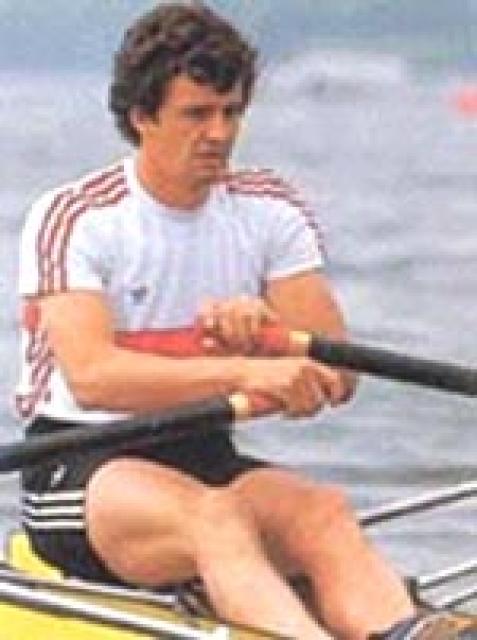
Piter-Mihael Kolbe
 Germany
- Peter-Michael Kolbe: A Biography
- Early Life and Career
- Olympic Heartbreak
- Continued Rivalry and Olympic Triumph
- Life After Rowing
Peter-Michael Kolbe: A Biography
Peter-Michael Kolbe, a German rower, is perhaps one of the most deserving athletes to complain about his "Olympic fate". He won five World Championships in single sculls but fell just short of the coveted gold medal in three Olympic finals. Born on August 2, 1953, in Hamburg, Federal Republic of Germany, Kolbe's achievements include three Olympic silver medals (1976, 1984, 1988), five-time World Champion (1975, 1978, 1981, 1983, 1986) in single sculls, 10-time Champion of Germany (1973-1988) in single sculls, and European Champion in 4 without coxswain (1973).
Early Life and Career
Peter-Michael Kolbe was born on August 2, 1953, in Hamburg, Germany, to a police officer and a housewife. His rowing talents, as well as his controversial character, manifested at an early age. In 1973, he won the Open European Championship in Moscow as part of the coxless four team for the German national team. However, after the races, he had a falling out with the coach and his teammates and decided to leave the team, stating that he would achieve success in single sculls. And he did achieve great success. In 1973 and 1974, he won the German Championship in single sculls, and in 1975, he became the World Champion in the same category. His victories were so remarkable that he was named the best athlete of the year in Germany in 1975.
Olympic Heartbreak
In the following year, Kolbe was the main Olympic hope for the Federal Republic of Germany and the favorite to win the gold medal in the single sculls event. Everything seemed to be going according to plan until the final race. Kolbe confidently took the lead, but Pertti Karppinen, his perennial rival, made an incredible sprint in the second half of the race and won with a margin of 2.64 seconds. It was one of the biggest upsets in Olympic history, and Kolbe was devastated. He went through a year-long recovery period before resuming his training.
Continued Rivalry and Olympic Triumph
Kolbe persevered and won the German Championships in single sculls in 1978 and 1979. In 1980, the Olympic Games in Moscow were supposed to settle the question of who was stronger between Kolbe and Karppinen, but due to political reasons, the Federal Republic of Germany decided not to participate, depriving Kolbe of a chance to compete for the gold medal. Karppinen went on to win his fourth Olympic gold medal. However, Kolbe did not give up. He won the World Championships in 1981 and 1983 and finally achieved his Olympic dream in 1988 in Seoul, where he defeated Karppinen and claimed the gold medal. But even then, fate was not on his side, as another great rower, Thomas Lange from the German Democratic Republic, emerged as a new talent and won the gold in the next Olympics in 1992.
Life After Rowing
After retiring from rowing, Peter-Michael Kolbe unexpectedly became the sports director of the German Rowing Federation. Over five years in this position, he worked tirelessly to unite the rowing community in the country, which had been divided for decades. However, he was unable to fully realize his plans for reorganizing the sport in the country. Currently, Kolbe resides in Norway with his wife, Ina Moberg, a Norwegian journalist who frequently covers major rowing regattas. Their son, Knut-Mikkel, is studying agriculture and has not shown any particular rowing talent. Kolbe works as an export manager for an air conditioning company. He now reflects on his rowing career with satisfaction, acknowledging that the years in rowing were a wonderful time in his life. Although he no longer watches rowing races, he will always be remembered as one of the greatest athletes in Olympic history.



