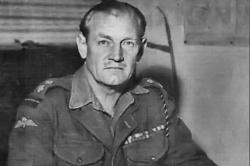
Primo Dzhibelli
 Italy
ItalyBiography of Primo Gibelli
Primo Gibelli was a bomber pilot and a national-revolutionary war hero in Spain. He was awarded the title Hero of the Soviet Union on December 31, 1936, and received the orders of Lenin and the Red Banner. Gibelli was born into a carpenter's family in Italy. Due to his parents' constant work, he was raised by his grandfather, a former Garibaldi soldier. Later, he moved with his parents to Turin, and at the age of 12, he lived with relatives in Besançon, France, where he completed three years of high school. Upon returning to Turin, Gibelli began working in a workshop while attending evening technical school. He later joined the Fiat factory, where he tested aircraft engines. Gibelli also became involved in the Youth Socialist Federation and actively participated in its activities. During this time, he met Antonio Gramsci and together they organized the workers' movement in Turin. Gibelli was arrested for agitating against Italy's expansion in Libya and propagating socialist ideas. After Italy entered World War I, he was exempted from conscription due to his expertise in aircraft engines. Gibelli enthusiastically welcomed the news of the overthrow of the Tsarist regime in Russia and was subsequently arrested again for organizing anti-war demonstrations by workers. He was later called up to the army but did not have the opportunity to participate in combat as the war had already ended. In 1919, he was demobilized and returned to the factory, but in September 1920, he was fired for participating in a strike. In the harsh conditions of the fascist terror and pogroms, he was forced to hide from the police and Mussolini's squadristi. In January 1921, the 17th Congress of the Italian Socialist Party (ISP) was held in Livorno. The left wing of the party, led by Gramsci, dissatisfied with its indecisive policies, left the congress and organized the founding congress of the Communist Party of Italy (CPI). Gibelli joined the CPI as one of its first members. After Mussolini came to power, the terror intensified. Progressive newspaper offices, workers' homes, and party sections were set on fire, and many communists and socialists were arrested, killed, or forced to emigrate. Gibelli was once again arrested, but he managed to escape and emigrate to the Soviet Union. In 1921, he joined the Red Army as a volunteer and became a member of the Communist Party. He participated in the Civil War, fighting against White Bandits in Ukraine as part of a special aviation unit in 1921-1922. In one of the battles, while skillfully maneuvering an armored car and firing a machine gun, he helped a group of Red Army soldiers escape from encirclement. On December 1, 1923, he graduated from the Zaraysk Aviation School No. 1. He then served in the "Ilyich" squadron of the air flank of the Ukrainian military district, first as a senior pilot and then as a flight leader. In 1924, Gibelli married Valentina Marats, the daughter of his comrade from the aviation unit, Valeriano Marats. He participated in the fight against White Bandits in the North Caucasus and Transcaucasia. During one of his flights, his plane was shot down and forced to make an emergency landing. Not losing his composure, he repaired the damage and took off in front of the approaching bandits. He soon captured one of the English instructors, who was a military advisor to the Dashnak detachments. In 1926, Gibelli was awarded the Order of the Red Banner for his courage and heroism. In the same year, his daughter Ernestina was born. In the spring of 1928, he distinguished himself again when he successfully located a group of fishermen stranded on an ice floe carried away by a storm in the Sea of Azov. He was awarded with honorary revolutionary weapons. From 1933, he served as a test pilot at the Air Force Research Institute. Unfortunately, he crashed during an unsuccessful attempt to fly under one of the Moscow bridges. After recovering, he was discharged from the army. He spent some time repairing aircraft engines and then worked at an automobile factory in Moscow. In 1934, Gibelli's parents, who had been persecuted by the fascists because of him, also emigrated to the Soviet Union. He participated in the national-revolutionary war in Spain from September to November 1936. Flying under the pseudonym "Caldero" on a two-seat light bomber Breguet 19 as part of the 1st International Bombing Squadron based in Albacete, he frequently had to fly behind enemy lines and engage in aerial combat, displaying high flying skills and bravery. According to his comrades' recollections, he was a very good friend, cheerful, witty, and loved to sing Italian songs. In October 1936, Gibelli's Breguet was seriously damaged during a combat sortie, and he was subsequently assigned as the commander of one of the twin-engine bombers of French production, the Potez 54. On November 4, 1936, two crews led by Gibelli were tasked with destroying enemy positions west of Madrid. As they approached the target, nine Heinkel He-51 fighters appeared from the clouds below and behind the bombers. The air gunners quickly noticed them and returned fire. At that moment, eleven I-15 fighters arrived and engaged the fascists, leaving the bombers alone. The bombers successfully completed their mission, accurately bombing the target and returning to their airfield without any losses. The I-15 fighters shot down four Heinkels, including the commander's aircraft. On November 10, 1936, the 1st International Bombing Squadron received the task to bomb enemy positions southwest of Madrid in the Alcorcín area. The raid was supposed to be accompanied by eight fighters. The squadron took off with four Potez aircraft from the Albacete airfield, heading towards the target. However, Gibelli's plane was missing when they emerged from the clouds. The squadron commander, La Rocca, who did not find the escort fighters, refused to carry out the mission and led the remaining planes back to the Alcalá de Henares airfield. The Republican fighters, unable to find their bombers, flew towards Madrid. They independently carried out the attack on the enemy positions near Casa de Campo and returned without any losses to their airfield. Primo Gibelli did not return from the mission. Colonel Demenchuk recalls: "Several hours after the ground forces command learned that only one Potez had bombed the target, it was reported that the plane had been shot down by anti-aircraft artillery, caught fire, and crashed on enemy territory. Infantry soldiers saw several people parachuting from the burning plane. As it was later announced, Gibelli, severely wounded, was captured. The fascists tortured and cruelly abused him for a long time, trying to make him disclose information about the positions of the Republican troops. But Gibelli died without speaking a word." Gibelli made 13 sorties on the same target, which was a huge and possibly unjustified risk. Ultimately, his plane was hit by an anti-aircraft shell. By the decree of the USSR Central Executive Committee on December 31, 1936, Primo Gibelli was posthumously awarded the title Hero of the Soviet Union.