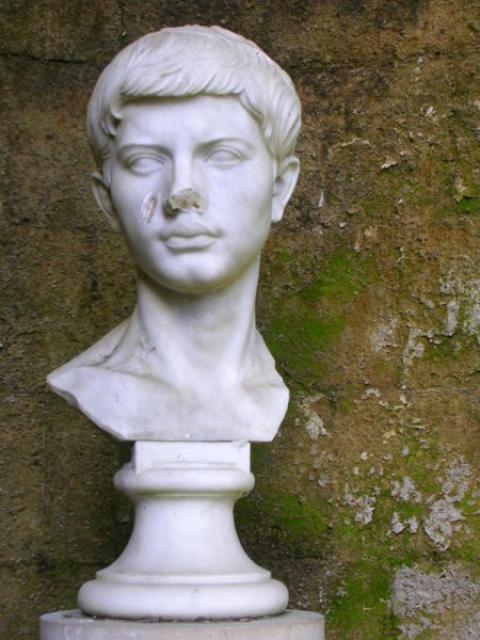
Publius Vergilius
 Italy
ItalyBiography of Publius Vergilius
Publius Vergilius, commonly known as Vergil, was one of the most significant ancient Roman poets. He created a new type of epic poem and became the most famous poet of the Augustan Age. Born in 70 BCE near Mantua, he received his early education in Cremona and at the age of sixteen, he was awarded the toga virilis, the symbol of maturity. This event coincided with the year of Lucretius' death, so Vergil was seen by his contemporaries as the direct successor to the poet of De rerum natura.
Vergil continued his education in Milan, Naples, and Rome, where he studied Greek literature and philosophy. Despite his interest in Epicureanism and his deep admiration for Lucretius, Vergil did not embrace Epicurean doctrine. He was more drawn to Plato and the Stoics. During this time, he wrote several minor poems, the most authentic of which is the Culet, recognized as Vergilian by Martial, Suetonius, and Statius.
After the death of Caesar, Vergil returned to Mantua and dedicated himself to studying Theocritus. However, his peace was disrupted by civil wars. During the distribution of land to veterans who supported the triumvirs after the Battle of Philippi, Vergil twice faced the danger of losing his properties in Mantua, but each time he was saved by Octavian's personal intervention. In gratitude, Vergil dedicated two panegyric eclogues (I and IX) to Octavian. In Rome, where Vergil often visited to attend to his properties, he became acquainted with Maecenas and the poets surrounding him. Later, he introduced Horace into this circle, and both poets undertook a journey to Brundusium together, which they both celebrated in their works.
In 37 BCE, Vergil completed the Bucolica, his first mature work, and at the request of Maecenas, he began working on the Georgica, written in Naples in 30 BCE. In 29 BCE, after much preparation, Vergil started working on the Aeneid and spent several years on it in Italy. He then traveled to Greece and Asia to study the locations of his poem in order to give it more realism. In Athens, he met Augustus, who convinced him to return to Italy. However, Vergil fell ill on the way to Rome and died in Brundusium in 19 BCE. Before his death, he requested that his unfinished and, in his opinion, imperfect epic poem be burned. Some scholars interpret this request as evidence that Augustus' reign made Vergil realize that he had been singing the praises of a tyrant his whole life, and he felt remorse that his epic would grant him immortality.
Vergil's first major work, the Bucolica, attempted to introduce Greek characteristics, simplicity, and naturalness into Latin poetry, starting with his imitation of Theocritus. However, he did not succeed in achieving these goals, as simplicity and naturalness are absent in his Eclogues. While Theocritus' shepherds truly lived a modest life as children of nature, whose only concerns were the prosperity of their herds and the love of their shepherds, Vergil's shepherds are poetic fictions, artistic images masking the complaints of the Romans about the adversities of civil wars. Some of the Eclogues present remarkable figures of that time, such as Caesar in the Daphnis. The most famous and truly interesting Eclogue, in terms of its solemnity and detailed description, is the fourth Eclogue (Pallio), in which Vergil predicts the coming golden age and the imminent birth of a child who will change the course of life on earth. The poet paints a picture of this future happy life, where all labor will be unnecessary and man will find everything he needs everywhere. Christian writers saw in this Eclogue a prophecy of the birth of Christ, and it is mainly on this Eclogue that the widely spread belief in Vergil as a magician in the Middle Ages is based. It is more likely that Vergil had in mind in this poem the son of Augustus, Marcellus, whose premature death he later sang in a poetic episode of the sixth book of the Aeneid. The general character of the Eclogues reflects the desire for peace that pervaded all Roman society.
The literary value of the Bucolica lies mainly in the excellence of the verse, surpassing all previous Republican Roman poetry. The Georgica, Vergil's second poem, was written with the aim of inspiring love for agriculture in the hearts of veterans who were rewarded with lands. Following the example of Hesiod, Vergil, however, does not delve into all the details of agriculture, but rather aims to depict the charms of rural life in poetic images, rather than to write rules on how to sow and harvest. Therefore, details of agricultural work only interest him where they have poetic interest. From Hesiod, Vergil only took the indications of fortunate and unfortunate days and some agricultural practices. The best part of the poem, which includes natural philosophical digressions, is mostly borrowed from Lucretius.
The Georgica are considered Vergil's most perfect work in terms of the purity and poetic completeness of the verse. They also reflect the poet's character, his views on life, and his religious beliefs. The poem is a poetic study of the dignity of labor. In Vergil's eyes, agriculture is the sacred struggle of humans against the earth, and he often compares the details of agricultural life to military life. The Georgica also serve as a protest against the growing atheism in the late republic. Vergil helps Augustus revive the Romans' fading faith in the gods, and he himself is sincerely convinced of the existence of a higher Providence governing humanity.
The Aeneid is Vergil's unfinished patriotic epic, consisting of 12 books written between 29-19 BCE. After Vergil's death, the Aeneid was published by his friends Varius and Plotius without any alterations, but with some abridgements. It is likely that the Aeneid was intended, like the Iliad, to have 24 books. The twelfth book ends only with the victory over Turnus, while Vergil wanted to tell the story of Aeneas' settlement in Latium and his death. The plot of the epic revolves around Aeneas, who founds a new Troy in Rome and becomes the progenitor of the gens Julia, from which Augustus descends. Vergil took up this subject at the request of Augustus to inspire national pride in the Romans by recounting the great destinies of their ancestors and to protect Augustus' dynastic interests, claiming that he is a descendant of Aeneas through his son Julius or Ascanius. In the Aeneid, Vergil closely approaches Homer, and in the Iliad, Aeneas is the hero of the future. The poem begins with the last part of Aeneas' wanderings, his stay in Carthage, and then episodically recounts previous events, such as the destruction of Troy (Book II), Aeneas' wanderings after that (Book III), his arrival in Carthage (Books I and IV), his journey through Sicily (Book V) to Italy (Book VI), where a new series of romantic and martial adventures begins. The execution of the plot suffers from the general flaw of Vergil's works - a lack of originality and strong characters. The hero, "pious Aeneas," lacking any initiative, is guided by fate and the decisions of the gods, who favor him as the founder of a noble race and the fulfiller of a divine mission - the transfer of the Lare to a new homeland. In addition, the Aeneid bears the imprint of artificiality. In contrast to Homer's epic, which emerged from the people, the Aeneid was created in the poet's mind, without connections to popular life and beliefs. Greek elements are mixed with Italian, mythical legends with history, and the reader constantly senses that the mythical world serves only as a poetic expression of national ideas. However, Vergil used all the power of his verse to embellish psychological and purely poetic episodes, which constitute the immortal glory of the epic. Vergil is unmatched in describing tender nuances of feelings. It is enough to recall the pathos-filled, yet simple, description of the friendship between Nisus and Euryalus, the love and suffering of Dido, and Aeneas' meeting with Dido in the underworld. These episodes demonstrate the poet's unsuccessful attempt to exalt the glory of Augustus at the expense of ancient traditions. Among the 12 books of the Aeneid, the sixth book, which describes Aeneas' descent into the underworld to meet his father Anchises, is considered the most remarkable in terms of philosophical depth and patriotic sentiment. In it, the poet presents Pythagorean and Platonic teachings about the "soul of the world" and recalls all the great people of Rome. The external structure of this book is taken from the 11th book of the Odyssey. There are also numerous borrowings from Homer in other books.
In the construction of the Aeneid, Vergil emphasized his desire to create a Roman parallel to Homer's poems. Most of the motifs of the Aeneid are found in previous adaptations of the story of Aeneas, but the choice and arrangement of these motifs belong to Vergil himself and are subordinated to his poetic task. He not only follows Homer in the overall structure, but also in the sequence of events and the stylistic treatment (comparisons, metaphors, epithets, etc.), Vergil competes with Homer.
The heroes in Vergil's portrayals are atomistic, living outside their environment, and being puppets in the hands of fate. However, this reflects the life perception of the dispersed society of Hellenistic monarchies and the Roman Empire. The main character, "pious" Aeneas, with his unique passivity and voluntary submission to fate, embodies the ideal of Stoicism, which became almost the official ideology. The poet himself acts as a preacher of Stoic ideas: the depiction of the underworld in the sixth book of the Aeneid, with the torments of the wicked and the bliss of the righteous, is in line with Stoic concepts. The Aeneid was only completed in draft form. However, even in this unfinished state, the Aeneid stands out for the high perfection of its verse. In it, Vergil deepens the reform he began in the Bucolica. In terms of minor poems, in addition to the aforementioned Culet, Vergil is attributed to Ciris, Moretum, and Sora. In his poetry, as well as in his personal life, Vergil is more a man of emotions than thoughts. "Bonus," "optimus," "anima candida" - these are the epithets that constantly accompany his name in the works of Horace, Donatus, and others. In his poetry, Vergil is not so much a philosopher as he is deeply interested in philosophical issues that concerned Republican Rome, and he would have liked to follow in the footsteps of Lucretius. However, he feels his powerlessness and sadly exclaims to Lucretius in the Geor. II ("Fortunate is he who has been able to know the causes of things…Fortunate too is he who knows the rustic gods…"). Everything related to philosophical systems in the Aeneid and Georgica is directly borrowed from various Greek authors (such as the "teaching of the afterlife" in Book VI, and others). In politics, Vergil is one of Augustus' most ardent supporters. Full of enthusiasm for Rome's great past, he sincerely praises the establishment of peace in Italy. Augustus, for him, represents the national idea, and he worships him without any hint of flattery, which is foreign to his pure soul. The reverence that surrounded Vergil's name during his lifetime continued after his death. Starting from the Augustan Age, his works were studied in schools, commented on by scholars, and used for divination, like the Sibylline oracles. The so-called "Sortes Virgilianae" were popular during the time of Hadrian and Severus. Vergil's name appears in Spanish, French, and German folk books, which attribute him to the time of the legendary King Octavian or King Servius. Breton legends speak of him as a contemporary of King Arthur and the son of a knight from "Campagna in the Ardennes Forest." Vergil is subject to the elements, miraculously lighting and extinguishing fire, causing earthquakes and storms. He is a patron or genius loci of Naples, which he founded by building it on three eggs (an alternative version is a castle built on an egg, Castello del'uovo). He carves out an underground passage through a mountain (Pozzuoli). He is an unsurpassed master, creating magical objects, including a complex signaling and defense system for the city using bronze statues called Salvatio Romae (or a system that protects against the eruption of Mount Vesuvius); a bronze fly that drives away flies from Naples and thus protects the city from disease; a magical mirror that reflects everything happening in the world; the Bocca della Verità; the eternal burning lamp; an aerial bridge, and more. The highest manifestation of the significance attributed to Vergil by the Middle Ages is his role as a psychopomp, given to him by Dante in the Divine Comedy. Dante chose him as the representative of the deepest human wisdom and made him his guide and conductor through the circles of Hell.
Vergil's works have come down to us in a large number of manuscripts, among which the most remarkable are the Medicean manuscript, probably written before the fall of the Western Roman Empire (published by Foggini in Florence in 1741), and the Vaticanus manuscript (published by Bottari, Rome, 1741). There are also numerous early printed editions, including the small folio edition of 1469, published by Sweynheym and Pannartz, the Aldine edition in Venice in 1501, several 15th and 16th-century editions with commentaries by Servius and others, the I. L. de la Cerda edition in Madrid, 1608-1617, and the edition by Nikolaus Heinsius in Amsterdam, 1676.


