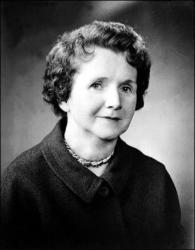
Rachel Carson
 USA
USABiography of Rachel Carson
Rachel Louise Carson was born on May 27, 1907, on a small family farm near Springdale, Pennsylvania. She had a great passion for books and spent a lot of time exploring the 26-acre farm of her family. At the age of eight, Carson started writing stories, often featuring animals, and her first story was published when she was eleven.

Carson was always drawn to the natural world, especially the ocean, and in January 1928, she switched her major from English to biology, although she continued working for the student newspaper and literary supplement. In 1929, she graduated with honors from Pennsylvania College for Women and spent the summer taking a course at the Marine Biological Laboratory before continuing her studies in zoology and genetics at Johns Hopkins University.

Her dissertation project focused on the embryonic development of the fish gill. Carson received a Master's degree in zoology in June 1932. After her father's death in 1935, Rachel cared for her elderly mother and faced increasing financial difficulties. She became a temporary employee of the U.S. Fish and Wildlife Service (FWS), wrote for an educational radio program called "Romance Under the Waters," and published several articles on marine life in the Chesapeake Bay. Eventually, her successful work at the FWS secured her a position as a junior biologist.

In the 1950s, Carson fully dedicated herself to writing on nature topics. Her breakthrough came in 1951 with the publication of the bestseller "The Sea Around Us," which made Carson a renowned writer and earned her the National Book Award. This was followed by a reissued version of her first work, "Under the Sea Wind," in 1941, and a new book, "The Edge of the Sea," in 1955, both of which also became bestsellers.

In the late 1950s, Carson shifted her focus to environmental conservation issues, particularly the harmful effects of synthetic pesticides. The result was her book "Silent Spring," published in 1962, which faced fierce opposition from chemical companies. Carson was accused of alarmism and labeled as someone who didn't understand how to write books of such caliber. Nevertheless, "Silent Spring" played a significant role in the ban of DDT and other pesticides and sparked the growth of the environmental movement.
In January 1937, Rachel's older sister passed away, leaving Rachel as the sole provider for her mother and two nieces. In mid-1945, she encountered DDT for the first time, a revolutionary new pesticide that was still undergoing safety testing, but she openly voiced her concerns about it only in 1962. In 1953, Rachel and her mother moved to Southport Island, Maine, where she became close friends with Dorothy Freeman, who was vacationing there with her husband. The women corresponded with each other, and there are speculations about a romantic connection between them. For unknown reasons, shortly before Rachel's death, Dorothy destroyed most of their correspondence.
In early 1957, tragedy struck Rachel's family again when one of her nieces passed away at the age of 31, leaving behind a 5-year-old son, Roger Christie. Carson adopted the boy and continued to care for her ailing mother, despite her own declining health. She moved to Silver Spring, Maryland, and in 1962, her controversial book "Silent Spring" was published, hinting at a bleak future for the natural world if serious measures were not taken to save it.
Suffering from breast cancer and undergoing intensive treatment, Rachel Carson became weakened and contracted a respiratory infection in January 1964. Her condition deteriorated, and in February, doctors discovered severe anemia, followed by the discovery of liver cancer in March. Carson died from a heart attack on April 14, 1964. She was posthumously awarded the Presidential Medal of Freedom by Jimmy Carter.