Rafael
 Italy
ItalyRaphael: The Prince of Painting
A Man of Harmony"Hic jacet Raphael, timuit quo sospite vinci, rerum magna parens et moriente mori." These are the words inscribed on Raphael's tomb in the Pantheon in Rome. It is hard to imagine that these words were about a mortal man. What kind of person must he have been to have his greatness compared to that of nature? Raphael lived during the Renaissance, a period known as the High Renaissance, which followed the Middle Ages and the horrors of the witch hunts and the Inquisition. It was a time when humanity suddenly recoiled at its own ignorance and cruelty. And in that moment of horror, it dared to believe in itself. "It was an era that needed titans," a philosopher once said, "and it produced titans, who astounded the world with the achievements of the human spirit." And one of those titans was Raphael, who gave people immortal hope through his depiction of the Madonna. He was the first among the three great geniuses of his time – Leonardo da Vinci and Michelangelo Buonarroti. He lived in the same century and country as these giants, but not even half as long as they did, and in the world of art even less. But in the hearts of people, he will forever remain the First among the Three. Legends about him and his "Sistine Madonna" continue to multiply around the world. Here is one of them, the simplest. Raphael was passing by a temple when he saw a young peasant woman breastfeeding a baby. Struck by her beauty, charm, and the sanctity of motherhood, he wanted to capture her in a painting, but he had no paper or cardboard. Without hesitation, he knocked out the bottom of a nearby barrel and... Another legend. The "Sistine Madonna" was being transported on a ship that was supposed to take her to Palermo. A sudden storm wrecked the ship on the rocks, and everyone and everything on board perished, except for the crate with the painting, which was thrown ashore intact and unharmed! However, let us return to real life and take a closer look at the young man entering the glorious city of Florence. Why at this moment? Simply because until then, very little was known about Raphael Sanzio. All that was known was that he came to Florence from his hometown of Urbino, where he became an orphan at the age of eleven and studied in the workshop of the renowned artist Pietro Perugino. As a young man, he was in awe on the streets of Florence. He was mesmerized by the "David" by Michelangelo. He couldn't take his eyes off the Santa Maria del Fiore Cathedral, designed by Brunelleschi. And all around, people were talking about the mysterious "Mona Lisa" by Leonardo, his astonishing cartoon of the "Battle of Anghiari," and the challenge posed to him by Michelangelo, who had just revealed his "Battle of Cascina" to the city. Raphael was directed to Maestro Michelangelo's house. Half an hour later, he entered the workshop of the gloomy man, cluttered with blocks of marble, introduced himself, and asked to see the cartoon that everyone was talking about. The sculptor, frustrated by his failures and enraged by the "ungrateful Florence" that paid him a fraction of what Leonardo received, had no time for visitors... But Raphael, a student of the respected Perugino, seemed to appeal to Michelangelo. Polite and delicate, not very tall, fragile, with long, thick hair down to his shoulders and beautiful eyes. After granting him permission to copy the cartoon of the "Battle of Cascina," Michelangelo noted a few hours later that Raphael's hand was determined, enduring, and skilled.
The young provincial was as amazed by Michelangelo's artistry as he was overwhelmed. It turned out that everything he knew how to do had long been surpassed and experienced in Florence. He had to start learning again! And he already knew his worth. When he was not copying Perugino, he painted on his own, and his works were much more tender and lyrical than his teacher's. He had surpassed his teacher. But his natural genius told him from whom and what he needed to learn anew to avoid losing himself in being an apprentice. In those days, Raphael turned twenty-one. It was 1504...
The Prince of Painting

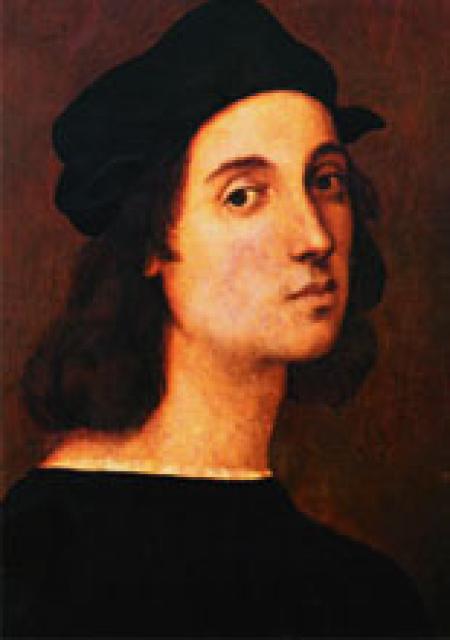
To enter Rome four years later and become a living legend within a year, one had to surpass oneself. And Raphael succeeded. Within two years, he painted his "Self-Portrait," which has no equal in world art. Looking at this pure, gentle, and bright face – an angelic countenance – one can understand Pope Julius II, who loved Raphael like a son. Some may argue that he was merely admiring himself as an artist. But his contemporaries thought differently, believing that "it was the hand of God that guided him." Indeed, the face is astounding not because of its beauty, but because of its spirituality. It reveals the main secret of Raphael: he was a man of harmony.
The ancient Greeks could bring the gods down to earth, and Raphael could elevate people to an ideal dream. Throughout his life, he painted Madonnas. And they were always beautiful, but more importantly, they were exquisite. Were they representations of the Virgin Mary? He named one of these paintings "The Madonna of Divine Love." But look at the others: "The Madonna in the Meadow," "The Madonna of the Goldfinch," "The Madonna of the Green"... Radiant and transformed by the generosity of Italian art, their colors unforgettable – young, beautiful mothers.
Were they entirely earthly – these blossoming women? A direct answer to this question is meaningless. One thing is certain: they were great women in whose images all the best – from earth and sky – converged. Yes, they were earthly, with a blush on their cheeks, tender skin, and high, maidenly breasts. And yes, they were heavenly, for their gaze was gentle and warm, and their entire appearance exuded deep modesty. As for the "Sistine Madonna," surrounded by astonished angelic beauty and saints, she seems to descend from heaven, getting closer and closer to us...
He painted it in 1514, at the height of his fame. But few know that the prototype for the "Sistine Madonna" was found by Raphael much earlier. Among the paintings he brought to Rome was the "Donna Velata," painted with a woman named Margherita from Siena. The extraordinary mystery inherent in Raphael prevented anyone from knowing why he turned to her again when preparing to create his most important Madonna.
The Prince of Painting

In the days when Michelangelo, having driven away a dozen ordinary assistants, took on the task of painting the Sistine Chapel alone (!), a young Raphael appeared in Rome. But if during their first meeting in Florence, he felt like a student, now he himself had become an unmatched master. However, remembering the lessons of the past, he would visit the Sistine Chapel to observe the maestro at work. Michelangelo would climb ladders under the high ceiling, painting severe biblical scenes on the vaults. It was an unimaginable effort. Only the "Deluge" alone required 32 days of nearly continuous work. Another artist would have been terrified by such a spectacle and would have been deterred forever, but Raphael reacted differently. He went to his own studio and, forgetting everything else, worked day and night.
His paintings were so elegant and charming that Pope Julius II was filled with indescribable joy, and he soon entrusted Raphael with the task of decorating the Stanza rooms in his new apartments in the Vatican. One of these frescoes, the "School of Athens," became, alongside Michelangelo's Sistine Chapel, the pinnacle of monumental painting for all time and all nations.
When one thinks of Raphael, one wonders what set him apart from the constellation of artists – the titans of the Renaissance? Was it his impeccable drawing? But weren't there others who possessed that skill? Was it his sense of color? He was not the only master in that regard either. But there is one thing that is common and perhaps the most important in any form of art. A writer thinks of the entire scope of a novel, all the interactions of its characters. The same applies to the composition in painting. And it was in composition that Raphael had no equal. He saw the world as beautiful, considered humans the center and crown of the universe.
A complete, harmonious person living in a world that was not separate from him, portrayed with the dignity inherent in a human being – that was his program, brilliantly embodied in the "School of Athens." Under the grand vaults of the magnificent Temple of Knowledge, philosophers of antiquity found themselves at ease. But they came here not to argue but to seek and find an alliance among thinking beings called humans. The composition underscores this idea. It is so free and profound that the fresco seems to expand, filling the air in the narrow rooms of the Vatican...
There are whole libraries written about Raphael's life as a person, artist, and creator. It is understandable because he, more than anyone else, celebrated the spiritual thirst of humanity and its tender closeness to God. However...
Every phenomenon has its flip side. When he put down his brush and, along with it, his intimate conversations with the Almighty, the artist transformed into a mortal who was not a stranger to earthly pleasures. Receiving generous support from Pope Julius II, Raphael rented a luxurious villa, where he housed his beautiful mistress and a staff of servants. He could be seen everywhere in Rome, and the whole city spoke of his unimaginable extravagance.
One evening, when Michelangelo, covered in paint and plaster, walked through St. Peter's Square in his smock, he saw Raphael approaching, dressed as if he were a prince. Raphael was festively attired, wearing fashionable high boots with silver buckles, a white batiste shirt, and a blue kaftan, surrounded by admirers. Michelangelo stopped him:
"Where are you going dressed as if you were a prince?"
"I am a prince. The prince of painting," Raphael retorted. And, in turn, he asked, "Where are you going alone, dressed as if you were an executioner?"
From Raphael's letters to his friend Castiglione, we learn about the torments of his soul. We understand that all his Madonnas were his great penance. And the most fervent of these prayers is the "Sistine Madonna."
The letters to Castiglione are perhaps the only direct evidence of Raphael's soul torment. The count once said, "Raphael knew how to keep his secrets. He was one of those people who would burn documents before their death."
However, Raphael's main documents of life are his works, which shine brighter and brighter for humanity from century to century.
Death and Resurrection
Raphael died as swiftly as he had lived, at the age of 37, from a fever he contracted in the Roman catacombs where he was conducting archaeological research. In his final years, he worked so tirelessly that he once confessed, "I hope not to be crushed under this weight."
He fell... His funeral was held at the Church of Santissima Trinità dei Monti, for which he had painted the most famous altarpiece in the world. Two centuries later, this priceless painting would be sold for seventy kilograms of gold and taken to Germany, becoming a treasure of the Dresden Gallery. During the Great Patriotic War, in 1945, it would lie in a damp, booby-trapped gallery – as Nazi fascism, on the verge of exiting the historical stage, prepared to slam the door. Russian soldiers would save it, to the credit of all humanity.
When the treasures of the Dresden Gallery, which had been stored in the storerooms of the Pushkin State Museum of Fine Arts for all those years, were shown to the people before being returned to Germany, many would remember that the "Sistine Madonna" by Raphael was long known and revered in Russia. Gogol, from his distant Italian journey, spoke of it with enthusiasm and reverence; the delirious Garshin clung to it like a source of living water; a reproduction of the Madonna hung above the dying Dostoevsky's head...
We will not forget the queue at the museum on Volkhonka Street: a dense crowd stretched for kilometers. We waited in that line for a whole week. And we remember how many people repeated the name of the painting we were eager to see, as if it were a prayer. Moscow was "on Raphael," on the "Madonna"!...
A few days before his death, as if sensing the end, Raphael painted his last picture – the "Transfiguration." In it, Christ, illuminated by unearthly light, rises from the earth. Doesn't this painting speak of Raphael's own transfiguration before his death? He helped the divine Madonna descend to the people, and he himself ascended to heaven...