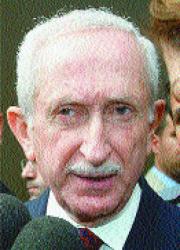
Rafik Hariri
 Lebanon
- Rafik Hariri: A Self-Made Man from Saida
- Appointment as Prime Minister
- Economic Stabilization
- Reconstruction and Investment
- Control and Criticism
- Opposition from the Elite
- Humble Beginnings and Saudi Connections
- Wealth and Global Influence
- Reconstruction of Downtown Beirut
- Controversy and Resistance
- "A Simple Lebanese Guy"
- A New Era for Beirut
- "Horizon 2000" Plan and Economic Success
- A Legacy of Renewal
Rafik Hariri: A Self-Made Man from Saida
On Sunday, September 3, Lebanon concluded the second round of its parliamentary elections. Incumbent Prime Minister Salim al-Hoss conceded defeat, with pundits predicting that former leader Rafik Hariri would once again lead the government.
Appointment as Prime Minister
In October 1992, Lebanese President Elias Hrawi appointed 46-year-old Hariri, a Saudi Arabian construction magnate and billionaire of Lebanese descent, as Prime Minister. His appointment was seen in Beirut as a final chance to save the war-torn nation.
Economic Stabilization
Capitalizing on the relative political stability, Hariri stabilized the currency by allegedly using his own cash to increase its value by 30% against the dollar. His team then sold his dollars over the first three months to counter currency speculation. As the Prime Minister explained: "The currency has been stabilized because I am heading the government. There is no other reason."
Reconstruction and Investment
The stabilized currency allowed Hariri to bring back $2 billion in savings from Lebanese expatriates, increasing bank deposits by over 20%. This enabled him to launch a 10-year, $12 billion program to rebuild Lebanon. Hariri oversaw this reconstruction, investing his own fortune in Lebanese real estate and becoming the country's largest media owner through newspapers, radio stations, and two television channels, including a 50% stake in state-owned Télé Liban. He also established the company Solidere with his own funds.
Control and Criticism
Hariri appointed loyalists from his companies to key government positions, creating a parallel state within the state. Many criticized him for using his power to benefit his own Sunni Muslim sect and create a political base. Despite calls for secular reform, Hariri failed to address the long-standing sectarian power-sharing system in Lebanon.
Opposition from the Elite
Hariri's rise threatened the status of established Muslim and Christian families who had ruled Lebanon for decades. Many of these elites had spent the civil war years in Europe or the United States, hoping to return and reclaim the country. However, Hariri's Saudi-backed control of Lebanon dashed their hopes.
Humble Beginnings and Saudi Connections
Hariri was born into a poor farming family in Saida. As a young man, he left Lebanon for Saudi Arabia, where in 1970 he caught the attention of Crown Prince Fahd, who made him a royal court contractor. Over the next two decades, Hariri's company, Oger Enterprises, built numerous projects for the Saudi royal family and Gulf emirates.
Hariri became a close friend of King Fahd and was granted Saudi citizenship, a prestigious honor for a foreigner. He adopted a Saudi accent and his sons greeted him with a hand kiss, a gesture common in Saudi Arabia but rare in Lebanon.
Wealth and Global Influence
Hariri's assets were estimated at $3-4 billion, placing him among Forbes' top 100 wealthiest people. His holdings included banks in the Middle East and Europe, a fleet of private jets, and one of the largest Quran publishers in Saudi Arabia. He also owned real estate on four continents, including a 75-story office building in downtown Houston.
Reconstruction of Downtown Beirut
In 1993, Hariri partnered with his Saudi backers to rebuild Beirut's central district. Critics claimed he aimed to prove his worthiness to King Fahd as a true member of the royal family. Hariri's plan, Solidere, appropriated much of the bombed-out downtown. Owners and tenants received 65% of company shares as compensation, while Solidere retained the remaining shares (valued at $650 million), which it sold to raise cash for infrastructure. Hariri acquired 19% of the publicly traded shares, making him Solidere's largest shareholder.
Controversy and Resistance
Hariri's plans faced opposition from landowners and urban planners. They accused him of manipulating the financial scheme to benefit himself and distorting the traditional character of downtown Beirut with its emphasis on modern architecture.
"A Simple Lebanese Guy"
Hariri dismissed his critics, declaring: "I am a simple Lebanese guy who made money in Saudi Arabia and who did not forget his people. The bigger my wealth became, the more I helped my country. It's in my blood." He intervened financially to pay salaries for university professors, street cleaners, and employees of Middle East Airlines. He also distributed scholarships and provided generous charity.
A New Era for Beirut
Two years after Hariri's appointment, a "new era for Beirut" was proclaimed. In September 1994, over 40,000 Lebanese joined hands in Martyrs' Square, singing along with legendary Lebanese singer Fairuz, who had vowed not to perform in her homeland until there was peace. In a flowing white gown and accompanied by 40 musicians, she sang, "I love you, my Lebanon!" Christians and Muslims, young and old, held hands and their voices echoed through the piles of rubble and shell-riddled buildings.
Prime Minister Hariri was among the crowd, singing with a Saudi accent. Days later, President Elias Hrawi laid a foundation stone for Solidere's reconstruction project near the demolished Monument to the Martyrs. The stone bore a single word: Beirut.
"Horizon 2000" Plan and Economic Success
Hariri's "Horizon 2000" plan covered 19 sectors, from education to waste disposal. He managed the program himself through the Council for Development and Reconstruction, which he revived shortly before becoming Prime Minister. Beirut's reconstruction proceeded rapidly, with over 150 buildings demolished in the city center. Artists' renderings of a transformed Beirut emerged everywhere.
Despite ongoing criticism, Hariri remained popular both at home and abroad. In 1995, Merrill Lynch issued Lebanese Eurobonds, backed by Banque Indosuez and Paribas. The $150 million bond issue was oversubscribed to $300 million and later increased to $400 million. Expected to be listed on the Luxembourg Stock Exchange, the three-year bonds opened the door for Lebanon to access global capital markets.
A Legacy of Renewal
While Lebanon may never regain its pre-war elegance as a Middle Eastern hub with a cosmopolitan atmosphere and Swiss-style banking secrecy laws, Hariri envisioned a new era in which Beirut would compete commercially with rising business centers like Cairo, Bahrain, Dubai, Tel Aviv, and Nicosia. Rafik Hariri, the self-made man from Saida, undoubtedly secured his place in Lebanese history as the man who rebuilt his war-ravaged country.