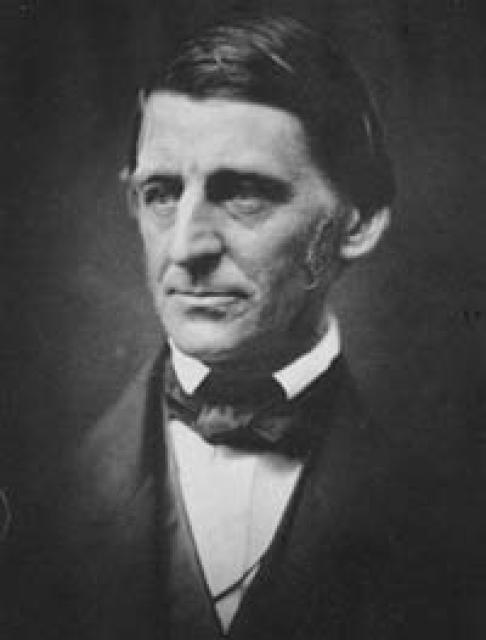
Ralph Waldo Emerson
 USA
USA- Ralph Waldo Emerson: American Philosopher, Essayist, and Poet
- Life and Works
- Philosophical Contributions
- Legacy
Ralph Waldo Emerson: American Philosopher, Essayist, and Poet
Ralph Waldo Emerson was an American writer and philosopher, known for his contributions to the transcendentalist movement. He was born on May 25, 1803 in Boston, Massachusetts. Originally a liberal minister in New England, Emerson abandoned his parish in 1832 after experiencing a "faith in the soul". He earned a living by giving lectures and gained international recognition by 1850.
Life and Works
After marrying in 1835, Emerson settled in Concord, Massachusetts, although his lecture circuit extended to Canada, California, England, and France. He periodically reworked his old lectures, compiling them into essay collections such as "Essays" (1844), "Representative Men" (1850), "English Traits" (1856), and "The Conduct of Life" (1860). He also published two volumes of poetry in 1846 and 1867, featuring poems such as "Brahma," "Days," "The Snow-Storm," and "Concord Hymn," which have become classics in American literature. Emerson passed away on April 27, 1882 in Concord. His posthumously published journals were released between 1909 and 1914.
Philosophical Contributions
Emerson's first book, "Nature" (1836), his historical address "The American Scholar" (1837), his "Address to the Divinity School Students" (1838), and his essay "Self-Reliance" (1841) were all written from the perspective of a young dissenter. He taught that true life begins when one trusts their inner strength, their "self," as the sole and sufficient means against all horrors that are "not self." According to Emerson, what is commonly referred to as human nature is merely an external shell, a crust of habit that submerges the innate powers of a person into an unnatural sleep. His philosophy rebelled against the 18th-century world of mechanical necessity and affirmed the sovereignty of the self. Over time, Emerson embraced the idea of natural evolution, which he absorbed from pre-Darwinian sources, and developed a growing appreciation for Eastern philosophy.
Legacy
Emerson's influence on the development of American thought and literature cannot be overstated. He was revered as a spiritual leader by the liberals of his generation and his ideas influenced writers such as Walt Whitman, Henry David Thoreau, Nathaniel Hawthorne, and Herman Melville. His ideas also inspired Emily Dickinson, E.A. Robinson, and Robert Frost. The distinctly "American" philosophical movement of pragmatism demonstrates clear affinities with Emerson's views, and his ideas were a source of inspiration for the "modernist" direction of Protestant thought. Emerson gained popularity in Germany and had a profound impact on Friedrich Nietzsche. In France and Belgium, Emerson was not as popular, although he did attract the interest of Maurice Maeterlinck, Henri Bergson, and Charles Baudelaire.