Ramakrishna
- A village childhood
- A life of spiritual practice
- The disciple who carried his message
- Final years and a lasting influence
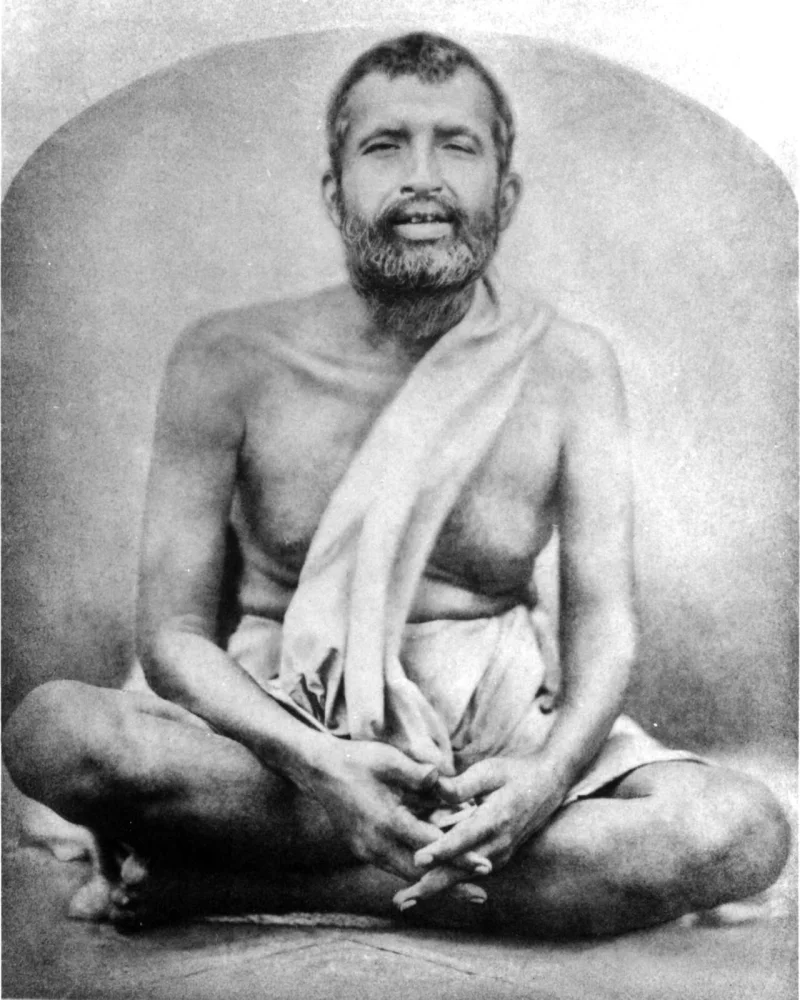
Ramakrishna became one of nineteenth-century Bengal’s most influential spiritual teachers through a life centered on devotion, religious practice, and conversations with people who came to see him. Born Gadadhar Chattopadhyay in a village family, he rose to prominence as a priest at the Kali temple of Dakshineswar near Calcutta. His intense worship of the Divine Mother, experiments across several religious traditions, and informal teaching drew a circle of followers that included the young Narendranath Datta, later known as Swami Vivekananda.
A village childhood
Gadadhar was born on 18 February 1836 in Kamarpukur, in the Hooghly district of Bengal. His parents, Khudiram and Chandramani, were poor Brahmins who valued religious devotion. As a child, he showed little interest in the formal schooling expected of him, but was drawn to devotional songs, village performances, and stories from Hindu epics. He was remembered for a vivid imagination and a natural ability to hold the attention of people around him.
In 1855, his elder brother Ramkumar became the chief priest at a new temple complex dedicated to the goddess Kali at Dakshineswar, built by the philanthropist Rani Rashmoni. Gadadhar joined him and soon took on temple duties himself, becoming known as Ramakrishna. The temple’s rituals gave him a daily focus for a devotion that, according to accounts preserved by his followers, often carried him into states of spiritual absorption. His longing to experience Kali directly became the defining force of his life.
A life of spiritual practice
Ramakrishna did not confine himself to one form of religious practice. He studied devotional traditions within Hinduism, including Vaishnava worship, and received instruction in Advaita Vedanta from the wandering monk Totapuri. Accounts by disciples also describe periods in which he practiced Islam and Christianity. He later taught that sincere devotion in different traditions could lead toward the same divine reality. The breadth of these explorations was striking in a period when Hindu reform movements and new forms of religious debate were reshaping Bengali life.
In 1859 his family arranged his marriage to Sarada Devi, then a young child, as was customary in their community. She later joined him at Dakshineswar as an adult. They lived as spiritual companions, and their relationship became central to the movement’s memory of both figures. Sarada Devi was revered by followers as the Holy Mother and, after Ramakrishna’s death, became a spiritual guide in her own right.
Although he had little formal education, Ramakrishna was an engaging teacher. He spoke in vivid parables drawn from village life, everyday work, and the natural world. His conversations were remembered by the householder disciple Mahendranath Gupta, who wrote under the initial “M.” and later published them in Bengali as the Kathamrita, translated into English as “The Gospel of Sri Ramakrishna.” The record helped carry his voice to generations who never met him.
The disciple who carried his message
By the 1870s, Ramakrishna’s reputation had reached Calcutta’s educated circles. He met reformer Keshab Chandra Sen and attracted a number of urban visitors who were searching for a way to reconcile religious experience with modern education and social change. In 1881 he met Narendranath Datta, a student known for his questioning mind and interest in whether anyone had directly experienced God. Their relationship began with sharp questions and gradually became one of the most consequential teacher-disciple partnerships in modern Indian religious history.
Ramakrishna’s most famous teaching was not a formal system but a way of approaching spiritual life through direct practice and personal experience. He encouraged his followers to seek the divine with sincerity and to respect the possibility that religious traditions could take different paths toward it. After his death, Vivekananda gave this inheritance a wider public form, presenting Vedanta to audiences in India and abroad and helping establish the Ramakrishna movement.
Final years and a lasting influence
In 1885 Ramakrishna’s health deteriorated, and he was diagnosed with throat cancer. His disciples moved him to a garden house in Cossipore, where they cared for him and gathered around him during his final months. He died there on 16 August 1886, aged 50. Before his death, he entrusted Vivekananda with guiding the young disciples who had begun to live together as a monastic community.
The organization that grew from this circle became the Ramakrishna Math and Mission, combining monastic life, spiritual teaching, education, and social service. Its scale was the work of later generations, especially Vivekananda, but the movement’s central inspiration remained the village-born priest who taught through stories, practiced across traditions, and drew people to him through the force of his religious conviction.