Mikhail Bakunin
- From military school to radical philosophy
- Revolution, arrest and exile
- Anarchism and the workers’ movement
- Ideas and legacy
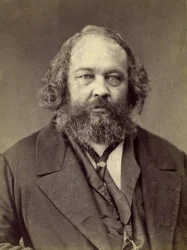
Mikhail Bakunin was a Russian revolutionary and philosopher whose uncompromising critique of state power helped shape modern anarchism. Born into the landed nobility, he rejected a military career and spent much of his adult life among Europe’s revolutionary movements. His life swung between uprisings, prisons and exile, while his ideas on collective freedom and the dangers of centralized authority made him one of the nineteenth century’s most influential anarchist thinkers.
From military school to radical philosophy
Bakunin was born on May 30, 1814, at the family estate of Pryamukhino in Tver Province, Russian Empire. His family belonged to the provincial nobility and owned estates worked by serfs. At fourteen he entered the Artillery School in St. Petersburg and later served as an officer, but he left the military in 1835. Drawn to philosophy, he moved to Moscow, where he studied German idealism and became deeply influenced by Hegel.
In 1840 Bakunin traveled to Berlin to continue his studies. He soon abandoned the prospect of an academic life for political activism. In the years that followed, he lived in several European cities, joined debates among radical thinkers and developed a vision of revolution that increasingly centered on popular action and the liberation of oppressed peoples. His early commitment to Pan-Slavism gave way to a broader revolutionary internationalism.
Revolution, arrest and exile
Bakunin took part in the revolutionary wave of 1848, including the Prague uprising and the Dresden insurrection of 1849. After the defeat at Dresden, he was arrested and sentenced to death in Saxony. The sentence was commuted, but he was transferred through Austrian custody and eventually extradited to Russia in 1851. He spent years in the Peter and Paul Fortress and Shlisselburg before being sent into Siberian exile.
In 1861 Bakunin made a dramatic escape from Siberia. Traveling east across the Russian Empire, he reached Japan, then crossed the Pacific to the United States and returned to Europe by way of New York and London. The escape turned him into a legendary figure in radical circles and brought him back into contact with Russian exiles and European revolutionaries.
Anarchism and the workers’ movement
In the 1860s Bakunin became one of anarchism’s leading organizers and theorists. He argued that freedom required the abolition of coercive political authority and the creation of a society based on voluntary association, local self-government and collective ownership. His collectivist anarchism differed from individualist approaches: he envisioned workers and communities managing production together rather than leaving property and economic power concentrated in private hands.
Bakunin joined the International Workingmen’s Association, commonly known as the First International, and became a prominent rival of Karl Marx. Their conflict was about more than personality. Marx favored organized political struggle by workers and saw a transitional workers’ state as necessary; Bakunin feared that any state, even one claiming to act for the proletariat, would create a new privileged ruling class. In 1872, after years of bitter disputes, Bakunin and his supporters were expelled from the organization at its Hague Congress, a split that widened the divide between anarchist and Marxist currents in the socialist movement.
Ideas and legacy
Bakunin wrote forcefully but often in a fragmentary, polemical style. His major works include “God and the State,” published after his death, and “Statism and Anarchy” (1873), written in Russian. Across his writing he attacked political, religious and economic institutions that he believed demanded obedience and reproduced hierarchy. His famous insistence that freedom must be built from below influenced anarchist and labor movements across Europe and beyond.
Bakunin spent his final years in Switzerland, still involved in revolutionary politics but increasingly in poor health. He died in Bern on July 1, 1876. His ideas remain influential and contested: admirers see a powerful defense of self-organization and resistance to domination, while critics point to the tensions between his call for spontaneous popular revolt and his own commitment to secret revolutionary networks. That tension was part of a life devoted to a radical question that still resonates: how can people build freedom without creating new rulers?