Ramon Serrano Suner
 Spain
SpainBiography of Ramon Serrano Suner
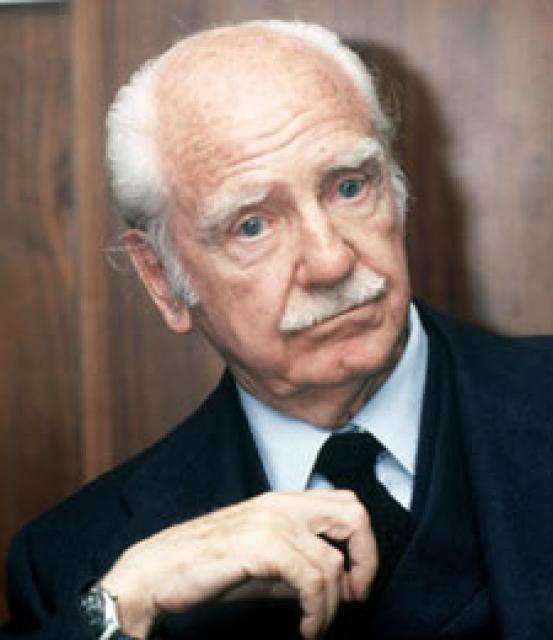
Ramon Serrano Suner was a Spanish political figure and lawyer who played a significant role during the Francoist era. He was the main author of the Francoist labor legislation, which was inspired by the corresponding Italian law of 1927. He also drafted a law on press censorship and was instrumental in the creation of various social institutions, including the Spanish National Organization for the Blind.
Early Life and Education
Serrano Suner was born into an engineer's family and spent his childhood and youth in Cartagena, Castellon-de-la-Plana, and Madrid due to his father's job transfers. He graduated with honors from the Law Faculty of the Central University of Madrid in 1923, despite his father's disapproval of his choice of a legal career. During his university years, he was involved in the activities of the Professional Association of Students, where he served as secretary under his friend Jose Antonio Primo de Rivera, the son of dictator Miguel Primo de Rivera and the future founder of the Spanish Falange.
Political Career
After completing his studies, Serrano Suner practiced law in Castellon-de-la-Plana and later joined the prominent legal firm Abogados del Estado in Saragossa. In 1929, he met and married Ramona ("Sita") Polo, the younger sister of Franco's wife, at the home of General Francisco Franco, who was then the head of the Saragossa Military Academy. The couple had six children.
Serrano Suner was elected as a deputy to the Spanish Parliament in 1933 representing the Spanish Confederation of Independent Right (CEDA) but later diverged from the party's leader, Jose Maria Gil-Robles, due to ideological and tactical differences. He maintained ties with the more right-wing Spanish Falange and played a significant role in the activities of the Juventud de Accion Popular (Youth of Popular Action), a far-right youth organization closely linked to CEDA. He actively facilitated the transition of many of its members to the Falange. In the 1936 elections, he was reelected as a deputy and was involved in the conspiracy against the government of the Popular Front. He organized a clandestine meeting between Franco, who had been removed as the Chief of General Staff, and Jose Antonio Primo de Rivera. However, he was not informed of the date of the military coup.
At the start of the Spanish Civil War in July 1936, Serrano Suner was in Madrid, where he was arrested by Republican forces despite his parliamentary immunity. He was imprisoned at the "Model Prison" in Madrid, but his friends secured his transfer to a private clinic where he received medical treatment for a stomach ulcer while remaining under guard. Among those who assisted him was Theodomiro Menendez, a socialist deputy, who later faced arrest in occupied France and extradition to Spain. Serrano Suner testified in his defense, which saved Menendez's life.
On January 20, 1937, wearing women's clothing, Serrano Suner escaped from the clinic and sought refuge at the Dutch mission. With false documents portraying him as a Republican soldier, he reached Alicante, where he reunited with his wife and children. They later embarked on an Argentine warship and arrived in Marseille. From there, Serrano Suner made his way to Salamanca, the temporary capital of the rebellious military forces led by his brother-in-law, who had become the head of state. He described himself as "traumatized and depersonalized" after his time in the Madrid prison.
Role in Francoist Regime
After the victory of the Francoists in the civil war, Serrano Suner became the head of the political faction within the Falange, while simultaneously serving as Minister of the Interior. He founded the state news agency EFE and made political overtures towards Nazi Germany during the early period of World War II. In September 1940, Franco sent him on a special mission to Berlin to discuss Spain's entry into the war against Britain. While Serrano Suner did not object to the idea, he insisted on Spain's acquisition of Gibraltar and French Morocco. The German side, in turn, demanded the transfer of one of the Canary Islands to Germany, Spanish Guinea, and Spanish-held islands near Central Africa in exchange for French Morocco and German participation in the mining industry in Morocco. During a personal meeting between Franco and Adolf Hitler in Hendaye on October 23, 1940, the Führer rejected the idea of transferring French Morocco to Spain to avoid conflict with the Vichy regime. This marked the end of the possibility of a compromise. A protocol was signed, which envisaged Spain's entry into the war, but the date of this event was to be determined by mutual agreement after the completion of Spanish military preparations. This formulation allowed Franco to avoid involvement in the war.
The German authorities considered Serrano Suner to be primarily responsible for Spain's refusal to join the war, believing that he influenced Franco in this regard. The contradictory nature of his position was evident during a meeting with William Donovan, a representative of the President of the United States. Serrano Suner stated, "We hope for Germany's victory in the current conflict and believe in it," but at the same time emphasized that Spain would not enter the war unless its "honor, interests, and dignity" were affected. His pro-German sympathies and anti-communism were demonstrated by his active participation in sending the "Blue Division" of Falangists to the Soviet-German front. This led to a conflict with pro-British and monarchist military leaders in Franco's circle, including Jose Enrique Varela and Alfredo Kindelan.
The conflict between the Falangists and the monarchists reached its peak in August 1942 when a Falangist activist threw a grenade at the "Carlists" participating in a religious ceremony in Begoña near Bilbao, led by General Varela. In protest against Franco's defense of the Falangists, Varela resigned, and his resignation was accepted. However, to maintain "balance," Franco dismissed Serrano Suner from his position as Minister of Foreign Affairs and removed him as the head of the Falange's political faction. This marked the end of his active political career. After his resignation, Serrano Suner led a prestigious law firm and remained a member of the Francoist Cortes (parliament) until 1957. He occasionally published articles in the conservative newspaper ABC and suggested that Franco make the regime more liberal. He also continued to admire Mussolini and regularly attended masses in his memory. In 1945, he presented Franco with a project for state reform aimed at liberalizing the regime, but Franco responded with the resolution: "Ha-ha." Serrano Suner supported Dionisio Ridruejo, a former Falangist leader turned radical opposition figure.
Serrano Suner wrote several memoirs and books, one of which he co-authored with Dionisio Ridruejo. His last book, "The Politics of Spain, 1936-1975," was published in 1995. He passed away at the age of 101, being the last prominent figure of the Civil War era.