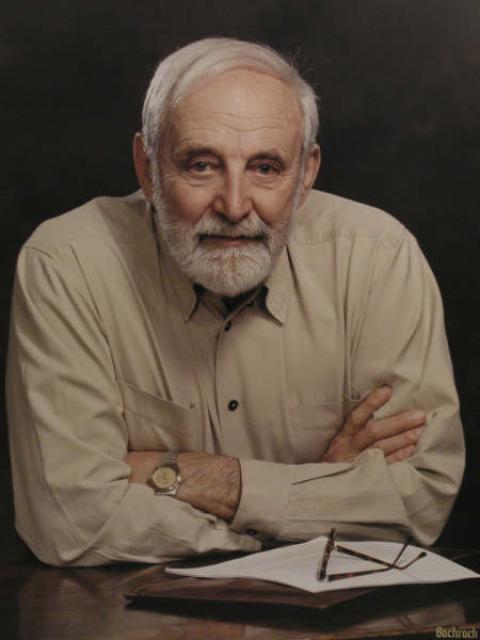
Raoul Bott
 USA
USA- Early Life and Education
- Academic Career
- Collaboration with Michael Atiyah
- Later Work and Legacy
- Key Achievements
Early Life and Education
Ralph Abraham Bott was born on March 10, 1923, in Budapest, Hungary. His family soon relocated to Czechoslovakia, fleeing the threat of Nazi occupation to Canada. Bott served in the Canadian forces in Europe during World War II.
After the war, Bott pursued his education at McGill University in Montreal, where he initially studied theoretical electrical engineering. However, his interests shifted towards pure mathematics, particularly differential geometry, topology, and especially algebraic topology.
Academic Career
In 1949, Bott joined the Institute for Advanced Study in Princeton, New Jersey, where he remained for the rest of his career. Initially, he worked on the homotopy theory of Lie groups using Morse theory techniques, introducing the concept of Morse-Bott functions.
Collaboration with Michael Atiyah
Bott's collaboration with Michael Atiyah proved immensely fruitful. Together, they developed topological K-theory, investigated periodicity in K-theory, and generalized fixed point theorems, famously leading to the "Woods Hole theorem" and the Atiyah-Bott fixed point theorem.
Later Work and Legacy
Bott and Atiyah continued their collaboration, extending Ivan G. Petrovski's results on hyperbolic partial differential equations and working on gauge field theory in mathematical physics. Bott also made significant contributions to the representation theory of Lie groups, leading to the Borel-Bott-Weil theorem.
Bott's mentorship of students, including notable figures like Stephen Smale and Daniel Quillen, helped shape the future of mathematics. He was awarded the prestigious Wolf Prize in Mathematics in 2000.
Key Achievements
Introduced Morse-Bott functions in homotopy theoryDeveloped topological K-theory with Michael Atiyah
Proved the Woods Hole theorem and the Atiyah-Bott fixed point theorem
Generalized Petrovski's results on hyperbolic equations
Made contributions to gauge field theory and representation theory
Mentored influential mathematicians like Stephen Smale and Daniel Quillen


