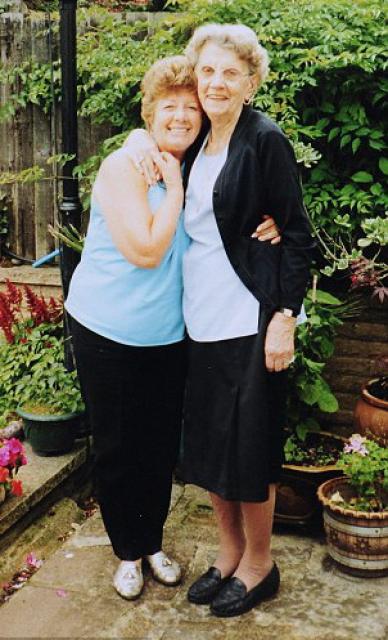
Rebecca Careswell
 Great Britain
- The Loss of a Cherished Memory
- A Mother's Last Days
- A Ring's Disappearance
- A Grieving Daughter's Plea
- A Widespread Problem
- Hospital Thefts: A Moral Dilemma
- An Array of Valuables Gone Missing
- Security Measures and Challenges
- A Legacy of Loss
The Loss of a Cherished Memory
At the age of 96, British woman Rebecca awaited her eternal rest. However, her final moments were marred by a callous theft that has become all too common in hospitals across the United Kingdom.

A Mother's Last Days
As Jean Pierce sat by her dying mother's bedside, her focus was solely on ensuring Rebecca's comfort in her final days. Suffering from dementia, Rebecca had recently fallen and fractured her pelvis, leaving her weak and in pain at London's Queen Elizabeth Hospital.
It was then that Jean realized her mother's gold wedding ring, a cherished possession for 76 years, was missing. "My mother was widowed at 46 when my father Alexander died suddenly of a heart attack. She never took her ring off," Jean explained. "It had always been there, but now there was nothing but a mark where it should have been."
A Ring's Disappearance
Despite inquiries with nurses, no one seemed to know where the ring had gone. "One nurse got quite angry," Jean recalled. "She said, 'Are you accusing my staff of something?' and just walked off. But eventually, a doctor confirmed that he remembered seeing the ring on my mother's finger when she was admitted."
An inventory of Rebecca's possessions at the hospital did not list her ring. Desperate, Jean contacted the police, who visited the hospital to investigate. Rebecca passed away a week later in April 2011.
A Grieving Daughter's Plea
"It shouldn't have happened and it would have been upsetting enough without this, but the thought that someone would actually stoop so low as to take a ring from a 96-year-old woman made it almost unbearable to bear," Jean said.
A Widespread Problem
Jean's family's experience is not an isolated incident. Ten years earlier, her 93-year-old mother-in-law's wedding ring vanished after she died in hospital. "It disappeared somewhere between the ward and the mortuary," Jean said. The case was also reported to the police, but no outcome was reached.
Hospital Thefts: A Moral Dilemma
Moral boundaries seem to blur for some hospital thieves. In the wake of a spate of thefts at the Royal Gwent Hospital in Newport, South Wales, the hospital resorted to "chaining up" toys in the children's ward as a deterrent. However, wedding rings and other valuable pieces of jewelry top the list of items stolen from hospital patients.
A patient at Maidstone Hospital lost a £4,000 wedding ring, while a necklace worth £2,000 was taken from a patient at Scarborough Hospital.
Stolen items also include money, mobile phones, watches, and wallets, with over 8,000 allegations of theft being reported in UK hospitals over the past three years. Employee theft has been identified in some cases, such as a hospital worker in Grimsby who pocketed a dying patient's iPhone and was dismissed. In another instance, a suspect was arrested and £265 stolen from a deceased patient was returned to the victim's family.
An Array of Valuables Gone Missing
Beyond valuables, wheelchairs, walking sticks, hearing aids, and glasses have also been reported missing. Many thefts target the elderly, but younger patients are not immune. Great Ormond Street Hospital for Children has reported the theft of three gaming consoles, a laptop, and even food from patients under the age of 10.
One patient at St. George's Hospital in Tooting, London, even reported the loss of an eye prosthesis. Another distressing case involved a breast pump and a baby's bathing kit being stolen from a mother.
Security Measures and Challenges
The Royal Berkshire Hospital identified bedside cabinets as a common location for items reported as stolen or missing in 107 cases. Providing patients with lockable bedside chests has been proposed as a solution. However, funding for new furniture remains a challenge, and some patients may be unable to operate the locking devices.
A Legacy of Loss
In the case of 96-year-old Rebecca Carruthers, the hospital paid £500 in compensation for the lost ring. Her daughter insisted the money be donated to charity.
"They'll never admit liability," Jean Pierce commented. "But they have said that they regret the incident very much and that more should have been done to look after the patient. But it's horrible."


