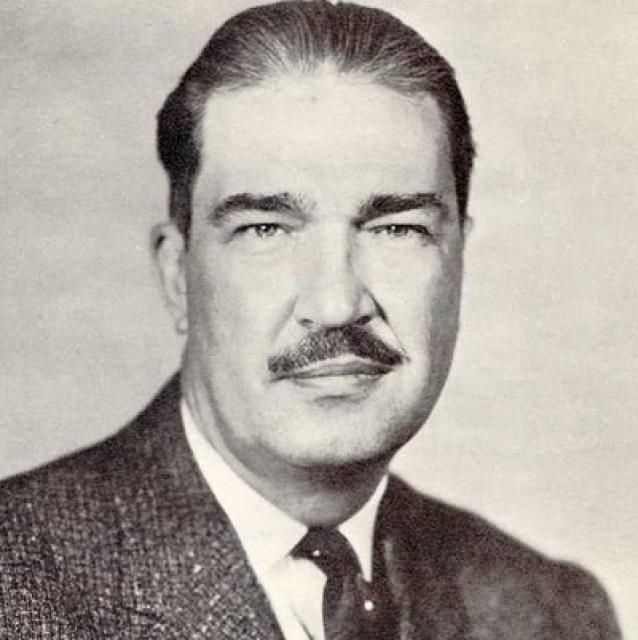
Revilo Oliver
 USA
USA- Early Life and Education
- Military Service and Academic Career
- Conservative Movement
- White Nationalism
- Later Years and Death
- Name and Pseudonyms
Early Life and Education
Reginald P. Oliver was born in 1908 near Corpus Christi, Texas. He attended high school in Illinois for two years. He underwent a "radical" mastoidectomy during that time. Oliver moved to California, where he studied Sanskrit under the guidance of a Hindu missionary. At age sixteen, he enrolled at Pomona College in Claremont, California.
In 1930, Oliver married Grace Needham. He returned to Illinois and pursued his studies at the University of Illinois under William Abbott Oldfather. His first book was an annotated translation from Sanskrit, "Mrichchakatika" (The Little Clay Cart), published by the University of Illinois in 1938. He earned a Ph.D. in 1940, with a dissertation titled "Niccolò Perotti's Translations of the 'Enchiridion' of Epictetus," which was republished in 1954 as "Niccolò Perotti's Version of the Enchiridion of Epictetus." Oliver began teaching as a graduate assistant and also lectured in Renaissance studies, covering Spanish and Italian subjects.
Military Service and Academic Career
According to his own account, Oliver served in the communications branch of military intelligence during World War II. He stated that he was part of the War Department from 1942 to the fall of 1945 and was "in charge of a staff of some 175." Oliver left Washington, D.C. in 1945. He joined the University of Illinois faculty as an associate professor in 1945, became a full professor in 1953, and retired in 1977 as a professor emeritus. He published minimally in academic journals, but gained notoriety for his politically conservative writings, expressing antisemitism and white nationalism.
Conservative Movement
Oliver co-founded National Review in November 1955 and served as an assistant editor under William F. Buckley. He also wrote for The American Mercury. Buckley, while seeking to make conservatism more acceptable to Americans resistant to antisemitism and extremism, maintained a close friendship with Oliver but privately acknowledged Oliver's antisemitism. He employed Oliver as a book reviewer for National Review for many years, eventually breaking ties over Oliver's 1964 article on the Kennedy assassination.
In 1958, Oliver became a founding member of Robert Welch Jr.'s anti-communist organization, the John Birch Society. He served on the National Council and as associate editor of the publication American Opinion. In 1962, Buckley disavowed Welch and the "Birchers," declaring them "preposterous" and urging the Republican Party to purge itself of Welch's influence. The rejection drove a wedge in Buckley's friendship with Oliver.
After the assassination of President John F. Kennedy, Oliver authored a two-part article titled "Marksmanship in Dallas," published in the March 1964 issue of the Birch Society's magazine American Opinion. It alleged that Lee Harvey Oswald committed the murder as part of a communist conspiracy to kill Kennedy, whom Oliver portrayed as a puppet who had outlived his usefulness. Oliver was censured by the University of Illinois Board of Trustees in March 1964 but was allowed to keep his position. He testified before the Warren Commission that fall.
White Nationalism
In 1966, Oliver embarrassed Welch by asserting that the world's problems would end if "all Jewry were wiped out tomorrow morning at sunrise" along with "the Illuminists" and "the Bolsheviks." Denouncing what he termed "the Birch hoax," he claimed that Welch had deceived him or had sold out to Zionist interests. He was "compelled to resign from the Society" on July 30, 1966. Later, in 1981, Oliver claimed to have discovered that Welch "was only the titular head of the Birch operation, which he presided over under the watchful guidance of a committee of Jews." Oliver is described as a "rabid anti-Semite" in Klary Conner's memoir about her time in the radical right, "Wrapped in the Flag: A Personal History of America's Radical Right." From the 1960s until his death, Oliver wrote essays accusing Jews of conspiracies.
Oliver subsequently became involved with Willis Carto's National Youth Alliance (NYA) in New York. He mentored William Luther Pierce, founder of the National Alliance and author of "The Turner Diaries." He also mentored neo-Nazi activist Kevin Alfred Strom. "Oliver’s writings on Jews and race mixing became an important part of neo-Nazi culture in the early twenty-first century," according to Andrew S. Winston of the University of Guelph.
In 1978, Oliver became an editorial consultant for the Institute for Historical Review, an organization primarily dedicated to Holocaust denial. He also was a regular contributor to the antisemitic journal Liberty Bell.
Although Oliver initially embraced Christianity as essential to Western civilization, he came to believe that Christianity, by emphasizing universalism and brotherhood rather than racial survival, was itself a Jewish product and part of a conspiracy. In a 1990 article, he characterized Christianity as a "spiritual syphilis" that had "rotted the minds of our race and paralyzed our will to live." Damon T. Berry, in his book "Blood and Faith: Christianity and American White Nationalism" (Syracuse University Press, 2017), devotes a chapter to Oliver, concluding that "Oliver despised both conservatism and Christianity… because they equally represented to him ideological poison that was inimical to the white race’s instinctual drive for self-preservation."
Later Years and Death
In 1994, suffering from leukemia and advanced emphysema, Oliver committed suicide at age 86 in Urbana, Illinois. His estate oversaw the posthumous publication of several works in Historical Review Press and Liberty Bell publications and provided for his wife Grace in her final years.
Name and Pseudonyms
"Revilo P. Oliver" is a palindrome, a phrase that reads the same forwards and backwards. Oliver wrote that his given name had been bestowed upon first-born sons in his family for six generations.
He used the pseudonyms "Ralph Perrier" (for "The Jews Love Christianity, the Religion, and Race Hatred") and "Paul Varner" (for "Aryan Pawns"). Oliver is sometimes credited as the author of the introduction (attributed to Willis Carto) to Francis Parker Yockey's "Imperium."




